
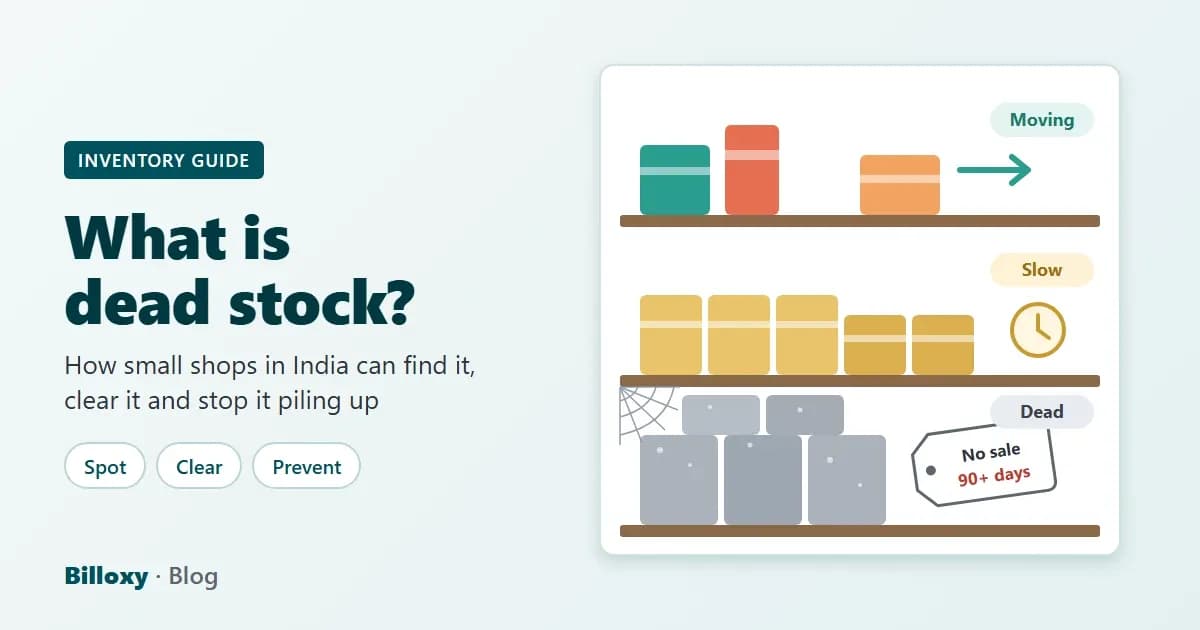
Dead stock is goods a shop has bought but cannot sell in a normal time: items unsold for months, out of season or close to expiry. It locks up cash and shelf space that fast-moving items need. Fix it in three steps: find it from your sales and stock records, clear it at a planned price, and reorder from actual sales.
Updated 21 October 2026. This guide is for owners of kirana and grocery stores, garment and footwear shops, electronics and mobile shops, hardware stores and small wholesalers. It covers the business side and the two GST points that matter when you discount or write off stock. It is not tax advice. For your own case, check with your accountant.
Why does dead stock happen?
Dead stock is rarely bad luck. It usually comes from one of these:
- Buying on a guess. The order is based on what sold well last season, what the distributor pushed, or a bulk scheme, not on what actually sold item by item.
- Seasonal leftovers. Festive packs, diyas, winter wear, school items and rakhi stock that did not sell before the season ended.
- Too many variants. Every size, colour and flavour is stocked, but only two or three actually sell.
- Slow-moving models. Phones, accessories and electronics lose value fast when a newer model arrives.
- Expiry and damage. Food, FMCG and medicines with short shelf life, or goods damaged in the godown.
- No record of what sold. When billing is on paper or in a notebook, nobody can say which items have not sold in 90 days, so the problem shows up only at the yearly stock count.
What does dead stock cost a small shop?
The purchase price is only the first cost. Dead stock also:
- Blocks working capital. Money spent on unsold goods is not available to pay suppliers, buy fast-moving stock or handle a slow month. See the difference between profit and cash flow for why a shop can show a profit and still be short of cash.
- Takes shelf and godown space that fast-moving items need, especially before a festive rush.
- Loses value every month as fashion changes, newer models arrive or expiry gets closer.
- Hides real profit. Stock counted at purchase price makes the books look better than the goods are actually worth.
A simple example. A garment shop in Indore buys 200 winter jackets at ₹600 each, ₹1,20,000 in total. By February, 70 are still on the rack. That is ₹42,000 of the owner's money sitting in stock until next winter, if the styles still sell then. (Illustrative figures.)
How do you find dead stock in your shop?
You need two numbers for every item: how much stock you hold, and when it last sold. Then sort.
- List every item with its current stock quantity and value (quantity × purchase price).
- Find the last sale date, or the units sold, for each item over the last 90 days. Choose a period that fits your trade: 30 days for fresh food, 90 days for FMCG and hardware, one season for garments and footwear.
- Mark three groups. *Moving:* sold steadily. *Slow-moving:* sold a little, much less than you hold. *Dead:* no sales in the period, or expiry is close.
- Sort the dead and slow-moving items by value. Start with the items that tie up the most money, not the most units.
- Walk the shelf. Check that the record matches what is physically there. Damaged or missing items need a stock adjustment, not a sale.
A useful ratio is months of stock: stock on hand ÷ average monthly sales of that item. If you hold 60 units and sell 5 a month, that is 12 months of stock, far too much for most shops.
How to clear dead stock: 7 options that work
Pick the option that recovers the most cash fastest. Holding out for full price usually costs more.
- Bundle it with a fast seller. Pair a slow item with a popular one ("buy a pressure cooker, get a slow-moving gasket set at half price").
- Run a planned clearance sale. Mark a clear discount on a fixed set of items for a fixed period. Show the discount on the GST invoice (see the GST section below).
- Move it to the front. Items at the back of the shop or in the godown do not sell. A counter display or a "today's offer" shelf often moves stock without a deep discount.
- Tell your regular customers. A short WhatsApp message or a printed offer flyer to customers who bought similar items works better than waiting for walk-ins.
- Return or exchange it with the supplier. Many distributors take back or swap unsold or near-expiry goods if you ask early. Check your purchase terms and keep the paperwork.
- Sell it to another trader. A wholesaler, a shop in another area or a stock-lot buyer may pay less than cost but more than zero.
- Write it off when nothing else works. Damaged, expired or unsaleable goods should be removed from stock and recorded. This has a GST effect, explained below.
What GST rules apply when you discount or write off stock?
Two rules from the CGST Act matter most to a small shop clearing dead stock.
Discounts shown on the invoice. Under Section 15(3) of the CGST Act, the value of supply does not include a discount given before or at the time of supply if it is duly recorded on the invoice. In practice: show the original price, the discount and the discounted price on the GST invoice, and GST is charged on the discounted price. A discount given later, after the sale, needs a credit note and has its own conditions in the same section.
Goods written off, destroyed or given away. Section 17(5)(h) of the CGST Act blocks input tax credit on goods lost, stolen, destroyed, written off or disposed of by way of gift or free samples. If you claimed input tax credit when you bought the goods and then write them off, that credit has to be reversed. Ask your accountant how to report the reversal for your return period.
Selling dead stock at a loss is still a sale: issue a normal GST invoice at the price you actually charge.
How to stop dead stock from building up again
- Reorder from sales, not memory. Before each purchase order, check how many units of that item sold in the last 30 to 90 days.
- Set a minimum and maximum level for each item. Reorder when stock falls to the minimum, and do not buy above the maximum even when a scheme looks attractive.
- Buy seasonal stock in two rounds. Order part early, and the rest after you see how the first lot sells.
- Cut slow variants. If two sizes or colours sell for every ten you stock, stock fewer of the rest.
- Check slow movers every month, not once a year at the stock count.
- Plan the post-season clearance before the season ends. After Diwali or the wedding season, clear leftovers while customers are still buying.
- Record every sale and purchase item-wise, so the numbers above are available without counting by hand.
Running out of popular items is the opposite problem. What is a stockout explains how to avoid empty shelves on the items that sell.
Dead stock checklist for this month
- List items with no sale in the last 90 days (or one season), with stock value
- Sort that list by value, highest first
- Check the shelf and record damaged or missing items as stock adjustments
- Ask suppliers about returns or exchanges for near-expiry and unsold goods
- Pick a clearance method for the top 10 items and a date to review it
- Show every clearance discount on the GST invoice
- Ask your accountant about ITC reversal on anything written off
- Set minimum and maximum levels for the items you reorder most
How Billoxy helps you keep stock moving
Billoxy is AI-powered GST billing, invoicing, inventory and business-management software for Indian MSMEs. It does not decide what you should stock, but it keeps the records that show what is and is not selling:
- One Items catalogue. Each product has its HSN/SAC, GST rate, units, barcode and prices in the Items master.
- Stock that follows billing. Sales and purchase documents update stock, and the Stocks screen records Stock In, Stock Out and bulk adjustments with history per item, so damaged or written-off goods can be adjusted out. See inventory management.
- Low-stock reminders. Reminder alerts you when stock runs low, so you reorder popular items on time instead of over-buying everything.
- Sales and purchase summaries. Reports give sales, purchase, expense and order summaries for any period, with export, to compare what you bought with what you sold.
- Ask in AI Chat. Billoxy's AI agents include business reports such as a product and service sales summary, and the marketing agent can help draft promotional content for a clearance offer. You can try them in AI Chat.
Running a retail shop? See billing software for retail stores. To bill and track stock in one place, start the 10-day trial or compare plans on pricing.
Questions shop owners ask about dead stock
What is the difference between dead stock and slow-moving stock?
Slow-moving stock still sells, just much less than you hold. Dead stock has not sold at all in the period you use (often 90 days or one season), or can no longer be sold because it has expired, been damaged or gone out of fashion.
After how many days is stock considered dead?
There is no fixed legal rule. Most shops use 90 days without a sale for FMCG, hardware and electronics, a single season for garments and footwear, and a much shorter period for fresh food. Choose a period that matches how fast your trade turns stock, and use it consistently.
Is dead stock a loss in the books?
Dead stock becomes a loss when you sell it below cost or write it off. Until then it sits in your stock value. Ask your accountant how to value slow-moving and damaged stock in your accounts at year end.
Do I charge GST on a clearance sale?
Yes. A clearance sale is a normal supply. If the discount is shown on the invoice at the time of sale, GST is charged on the discounted price, as Section 15(3) of the CGST Act provides.
Do I have to reverse input tax credit on dead stock I throw away?
Section 17(5)(h) of the CGST Act blocks input tax credit on goods that are lost, stolen, destroyed, written off or given away as gifts or free samples. If you claimed credit on those goods, it has to be reversed. Your accountant can tell you how to report it.
How can I avoid dead stock before the festive season?
Order festive stock in two rounds, base the first order on last season's item-wise sales, and plan a clearance date for leftovers before the season ends.