
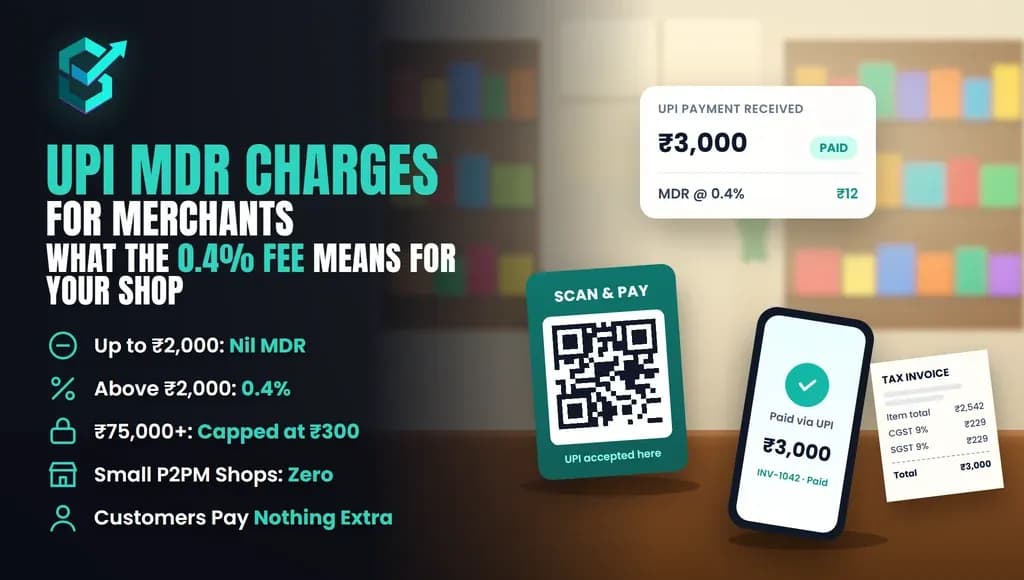
UPI MDR is the merchant discount rate a business pays its bank on certain UPI payments it receives. Under NPCI's framework, merchants pay 0.4% on person-to-merchant (P2M) UPI payments above ₹2,000, capped at ₹300 for payments of ₹75,000 and above. Payments up to ₹2,000 carry no MDR, customers pay nothing extra, and small P2PM merchants stay at zero.
Updated 20 October 2026. NPCI first set the start date as 15 October 2026. On 13 October 2026 it deferred the start until after Diwali, at a date it will notify separately. Until that date is notified, the fee is not being charged. This guide is for shop owners, traders and service businesses. It explains the rules NPCI has published and how to plan for them. It is not financial or tax advice. Check NPCI and your bank for the current position.
What is MDR on UPI?
The merchant discount rate (MDR) is the fee a business pays its acquiring bank or payment provider for accepting a digital payment. Cards have always had MDR. UPI did not, which is why most small shops prefer UPI QR codes.
NPCI's FAQ on MDR on select UPI (P2M) transactions, dated 15 September 2026, sets out the new framework. The UPI and Services Steering Committee, headed by NPCI, decides the rates and caps. NPCI says the money stays within the UPI ecosystem and goes to infrastructure, cybersecurity and customer service.
Two things do not change:
- Customers are not charged. Paying by UPI stays free for the person paying, whether they scan a QR at a shop or pay online.
- Person-to-person (P2P) transfers stay free. Sending money to family, friends or your own accounts carries no charge.
How much is the UPI MDR?
| UPI payment received by a merchant | MDR the merchant pays |
|---|---|
| Up to ₹2,000 | Nil |
| Above ₹2,000 and below ₹75,000 | 0.4% of the payment |
| ₹75,000 and above | Flat ₹300 (the cap) |
| Railways, telecom, insurance, fuel, utility bills (above ₹2,000) | Flat ₹5 per payment |
| Capital market payments (mutual funds, brokers) | 0.02%, capped at ₹300 |
| Small merchants under P2PM (up to ₹1 lakh a month) | Nil |
NPCI's own examples: a ₹3,000 payment costs the merchant ₹12. A ₹50,000 payment costs ₹200. A ₹1,00,000 payment would be ₹400 at 0.4%, but the cap holds it at ₹300. NPCI also says payments up to ₹2,000 make up more than 95% of P2M UPI volume, so most everyday shop payments are untouched.
For education fees above ₹2,000, NPCI's FAQ says flat-fee or capped rates apply but does not give the figure. Ask your bank if you collect school or tuition fees.
When does UPI MDR start?
Not yet. NPCI's 15 September FAQ said the framework would take effect from 15 October 2026. On 13 October 2026, NPCI announced that, keeping the festive season in mind, MDR on select P2M UPI payments will be implemented immediately after Diwali, on a date to be notified separately (NPCI press release).
So the October date you may still see on older pages and forwarded messages is out of date. Watch NPCI and your bank for the notified start date. We will update this page when NPCI announces it.
Does a small shop pay UPI MDR?
It depends on how your bank has set up your account, not on the size of a single payment.
- P2PM merchants pay nil. P2PM (person-to-person merchant) is NPCI's category for small vendors who receive UPI payments through a QR code straight into their own account, up to ₹1 lakh a month. NPCI's FAQ says these merchants keep zero MDR, even when a single payment is above ₹2,000.
- Crossing ₹1 lakh moves you to P2M. If your inward UPI receipts go above ₹1 lakh a month for three months in a row, your bank moves the account to the P2M category, and the 0.4% rule then applies to payments above ₹2,000.
- GST registration is not the test. NPCI says a small merchant does not need GST registration to get zero MDR. The test is the monthly collection limit and the account category.
- Your QR code keeps working. You do not need a new QR stand or soundbox.
If you are not sure which category you are in, ask the bank or payment provider that issued your QR code.
Can a merchant add the MDR to the customer's bill?
No. NPCI's FAQ says onboarded merchants cannot pass the MDR on to customers when accepting UPI payments. The customer pays the price on your bill. Treat MDR as a cost of collecting payment, the same way you already treat card fees.
That also means you should not add a "UPI charge" line to your GST invoice.
How to work out what UPI MDR will cost your business
You can estimate it from last month's records before the fee starts.
- List your UPI receipts above ₹2,000. Your bank or payment app statement shows each payment and its amount.
- Apply the rate. Multiply each payment from ₹2,001 to ₹74,999 by 0.4%. Count ₹300 for each payment of ₹75,000 or more. Payments of ₹2,000 or less add nothing.
- Compare with your margin. Look at the fee as a share of your monthly sales, not per payment.
Example. An electronics shop in Pune takes 40 UPI payments of ₹15,000 in a festive month, plus 600 small payments under ₹2,000. The 40 larger payments total ₹6,00,000, and 0.4% of that is ₹2,400. The 600 small payments cost nothing. If the shop also sells one item at ₹90,000 by UPI, that payment adds a flat ₹300.
A grocery store whose UPI payments are almost all below ₹2,000 would see little or no change.
How to record UPI MDR in your books
Keep the sale and the fee separate, so your sales and GST figures stay right.
- Bill the full amount. The GST invoice and your sales register show the full price the customer paid. MDR does not reduce your sale value.
- Record the receipt against the invoice. Mark the invoice paid with the amount the customer paid by UPI.
- Record the fee as a payment charge. The fee shows on your acquiring bank or payment provider's statement. Book it as a bank or payment charge expense, as your accountant prefers.
- Reconcile each month. Match UPI receipts in your bank statement to your invoices, and check the fees charged against the rates above. A charge on a payment of ₹2,000 or less, or on a P2PM account, is worth raising with your bank.
- Ask about GST on the fee. If your bank or payment provider charges GST on its fee, it will show on their invoice or statement. Ask your accountant how to book it and whether you can claim input tax credit on it.
How Billoxy fits in
Billoxy is AI-powered GST billing, invoicing, inventory and business-management software for Indian MSMEs. When a customer pays, you record the money in Payment In: choose the party, Cash or Bank, the amount and the sales invoice it settles. The invoice then shows as Paid or Partial, and the dashboard's To Collect figure shows what is still outstanding. The Payment In module guide shows each step.
Billoxy does not process UPI payments, decide your MDR category or calculate bank fees. Those stay with your bank or payment provider. What Billoxy gives you is a clean record of every invoice and every payment against it, which makes the monthly check against your bank statement easier.
To keep your GST invoices and collections in one place, start the 10-day trial or compare plans on pricing.
Questions merchants ask about UPI MDR
Is UPI free for customers after MDR?
Yes. NPCI says consumers will not be charged for UPI payments, and UPI apps may not add a platform fee. MDR is paid by the merchant only.
Is there a charge on UPI payments above ₹2,000?
For P2M merchants, yes, once MDR starts: 0.4% of the payment, capped at ₹300 for payments of ₹75,000 and above. The customer still pays nothing extra. P2PM merchants pay nil.
Is UPI MDR charged on payments of exactly ₹2,000?
No. NPCI's table shows nil MDR on a ₹2,000 payment. The 0.4% rate applies only above ₹2,000.
Do I pay MDR on UPI AutoPay payments?
NPCI's FAQ says UPI mandates (AutoPay) for recurring payments such as utility bills and subscriptions do not carry the prescribed MDR.
Does MDR apply to RuPay credit cards on UPI?
The new MDR covers payments from a customer's bank account to a merchant account. NPCI says credit-linked UPI payments, such as RuPay credit cards on UPI or bank credit lines, follow separate credit product rules. Ask your bank for those rates.
Has the UPI MDR start date been announced?
Not yet. On 13 October 2026 NPCI said MDR will start immediately after Diwali, on a date it will notify separately. Check NPCI and your bank for the notified date.
Official sources
- FAQs on Merchant Discount Rate (MDR) on select UPI (P2M) transactions — NPCI, 15 September 2026
- UPI MDR on select merchant transactions shall be implemented post Diwali — NPCI press release, 13 October 2026
- UPI circulars — NPCI