
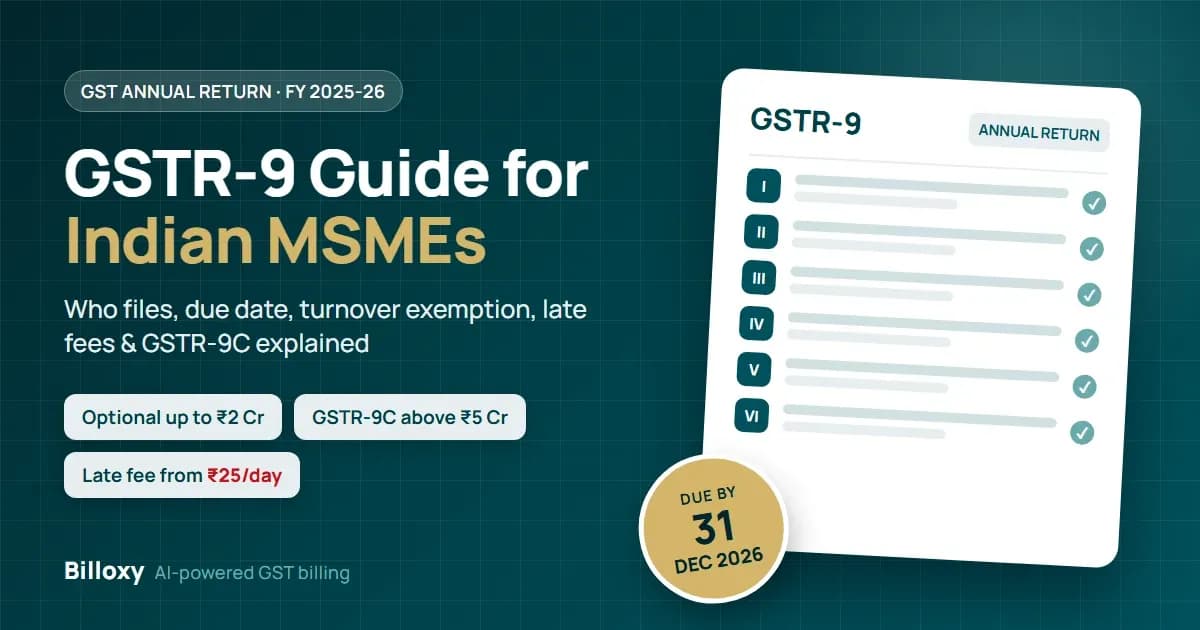
GSTR-9 is the annual GST return a regular taxpayer files once for each financial year. It brings together what you already reported in GSTR-1 and GSTR-3B for that year. The standard due date is 31 December after the year ends, so GSTR-9 for FY 2025-26 is due by 31 December 2026 unless the Government extends it.
Updated 14 October 2026. This guide explains GSTR-9 for small and medium businesses in plain words. It is not tax advice and not a filing manual. Check the current forms, advisories and any extension on the GST portal before you file, and use your accountant for anything you are unsure about.
What is GSTR-9?
The GST portal describes Form GSTR-9 as an annual return filed once for each financial year by registered persons who were regular taxpayers, including SEZ units and SEZ developers (GSTN FAQ on GSTR-9). The legal base is Section 44 of the CGST Act and Rule 80 of the CGST Rules.
In practice, GSTR-9 is a year-end summary. Much of it is filled from returns you have already filed: sales from GSTR-1, GSTR-1A and IFF, input tax credit (ITC) from GSTR-3B, and purchase data from GSTR-2B. Your job is to check those figures against your books and add what the form asks for that the monthly returns did not capture.
Who has to file GSTR-9?
Every person registered as a normal (regular) taxpayer during the financial year files GSTR-9, even if the GSTIN was active for only part of the year. That includes a business that moved out of the composition scheme during the year. If you hold more than one GSTIN, each GSTIN files its own GSTR-9.
| Type of registration | Annual return | Source |
|---|---|---|
| Regular taxpayer (files GSTR-1 and GSTR-3B) | GSTR-9 | GSTN FAQ; CBIC annual return flyer |
| Composition taxpayer | Not GSTR-9. The annual GSTR-4 replaced GSTR-9A from FY 2019-20 | CBIC annual return flyer |
| Casual taxable person, non-resident taxable person, Input Service Distributor, OIDAR service provider | No GSTR-9 | GSTN FAQ |
| TDS deductor (Section 51), TCS collector (Section 52) | No GSTR-9; e-commerce operators collecting TCS file GSTR-9B | CBIC annual return flyer |
Is GSTR-9 optional for small businesses?
It can be, but only when the Government notifies an exemption for that financial year. Section 44 lets the Commissioner exempt a class of taxpayers, and the Government has used it for small businesses year by year:
- FY 2017-18 to FY 2021-22: GSTR-9 was optional for aggregate annual turnover below ₹2 crore (CBIC annual return flyer).
- FY 2023-24: Notification No. 14/2024-Central Tax dated 10 July 2024 exempted registered persons with aggregate turnover up to ₹2 crore in FY 2023-24 from filing the annual return for that year.
The exemption is notified per year. Before you skip GSTR-9 for FY 2025-26, check that a notification for FY 2025-26 exists. Do not assume last year's relief carries over.
What is the GSTR-9 due date for FY 2025-26?
Rule 80 sets the due date as 31 December of the next financial year, "or as extended by Government through notification" (GSTN FAQ). That gives:
| Financial year | Standard GSTR-9 due date |
|---|---|
| FY 2024-25 | 31 December 2025 |
| FY 2025-26 | 31 December 2026 |
Extensions have happened before. The CBIC flyer records that the deadline for FY 2018-19 moved to 31 December 2020 and for FY 2020-21 to 28 February 2022. Treat 31 December as the date to plan for, and watch the portal for any change.
What do you need before filing GSTR-9?
The portal checks two conditions before it lets you file:
- Your GSTIN was active as a normal taxpayer for at least one day in that financial year.
- All GSTR-1 (or IFF) and GSTR-3B returns for that year are filed. GSTN's FY 2024-25 FAQ says GSTR-9 is not enabled while any GSTR-1 or GSTR-3B of the year is pending.
So the real deadline for a small business is earlier than 31 December: clear any pending GSTR-1 and GSTR-3B first, then start GSTR-9.
What does GSTR-9 contain?
The CBIC flyer splits GSTR-9 into six parts. A short map helps you know which of your records each part draws on.
| Part | What it covers | Records to keep ready |
|---|---|---|
| Part I | Basic details: financial year, GSTIN, legal and trade name | Registration certificate |
| Part II (Tables 4–5) | Outward and inward supplies for the year, taxable and non-taxable | Sales register, credit and debit notes, reverse-charge purchases |
| Part III (Tables 6–8) | ITC availed, ITC reversed, and other ITC details (Table 8A comes from GSTR-2B) | Purchase register, GSTR-2B for each month, ITC reversals |
| Part IV (Table 9) | Tax paid as declared in your returns | GSTR-3B for each period, cash and credit ledger |
| Part V (Tables 10–14) | Changes for the year declared in the next year's returns | Amendments, credit notes and ITC reversals made after 31 March |
| Part VI (Tables 15–19) | Demands and refunds, HSN-wise summary of outward and inward supplies, late fee | Refund orders, HSN-wise sales and purchase summary |
For FY 2024-25, GSTN made some table-level changes. Supplies added or amended through GSTR-1A now feed Tables 4 and 5. A new Table 6A1 separates ITC of the previous year claimed in the current year. The portal also gives an Excel download of HSN details from GSTR-1 to help fill Table 17 (GSTN FAQ on GSTR-9/9C for FY 2024-25). Read the FAQ or advisory issued for FY 2025-26 on the portal before you file, because table rules can change from year to year.
Can you claim missed ITC or fix mistakes in GSTR-9?
Partly. The rules are strict, so know them before you start:
- No new ITC through GSTR-9. The GSTN FAQ is clear that you cannot claim input tax credit through this return. Credit has to be taken in GSTR-3B within the legal time limit.
- Extra tax can be paid. If you find tax you did not declare in GSTR-1 or GSTR-3B, you can report it in GSTR-9 and pay it through Form DRC-03, choosing "Annual Return" in the drop-down.
- No revision. Once filed, GSTR-9 cannot be revised. Check every table before you submit.
What is the late fee for GSTR-9?
Section 47(2) of the CGST Act charges a late fee for each day the annual return is late. The State or UT GST Act carries a similar fee, so you pay both. For FY 2022-23 onwards, Notification No. 07/2023-Central Tax dated 31 March 2023 lowered the CGST fee for smaller businesses:
| Aggregate turnover in the year | CGST late fee | Maximum CGST late fee | With the matching SGST/UTGST fee |
|---|---|---|---|
| Up to ₹5 crore | ₹25 per day | 0.02% of turnover in the State/UT | ₹50 per day, up to 0.04% |
| Above ₹5 crore up to ₹20 crore | ₹50 per day | 0.02% of turnover in the State/UT | ₹100 per day, up to 0.04% |
| Above ₹20 crore | ₹100 per day (Section 47(2), no reduction) | 0.25% of turnover in the State/UT | ₹200 per day, up to 0.50% |
The portal works out the fee from your filing date, and you pay it before the return can be filed. CBIC Circular No. 246/03/2025-GST dated 30 January 2025 clarifies that the annual return is complete only when GSTR-9 and GSTR-9C (where it applies) are filed. GSTN's FY 2024-25 FAQ adds that the portal charges a separate late fee on GSTR-9C, counted from the GSTR-9 filing date or the due date, whichever is later.
For late fees on monthly and quarterly returns, see penalty for late GST filing.
Does the 57th GST Council meeting change GSTR-9?
Not directly, so far. The 57th GST Council press release of 8 October 2026 recommended a late fee waiver for taxpayers with turnover up to ₹5 crore in the preceding year when a return under Section 39(1) (the regular periodic return) is filed by the end of the month in which it was due. That is not the annual return under Section 44. The Council also approved in principle a concept note for an optional Annual Return Quarterly Payment (ARQP) scheme for B2C-only taxpayers up to ₹5 crore. Both are recommendations; they apply only after CBIC issues the notifications or the law is amended.
What is GSTR-9C and who files it?
GSTR-9C is a reconciliation statement. It matches the turnover, tax and ITC in your GSTR-9 with your audited annual financial statements. The CBIC flyer states that it applies to registered persons whose aggregate annual turnover in the year exceeds ₹5 crore, and that it is now self-certified by the taxpayer. You file GSTR-9C after GSTR-9, separately for each GSTIN.
| Point | GSTR-9 | GSTR-9C |
|---|---|---|
| What it is | Annual return | Reconciliation statement |
| Who files | Regular taxpayers (unless exempted for that year) | Aggregate turnover above ₹5 crore |
| Based on | GSTR-1, GSTR-1A, IFF, GSTR-2B and GSTR-3B for the year | GSTR-9 and audited financial statements |
| Order | First | After GSTR-9 |
Three MSME examples
1. Retail shop, turnover ₹1.4 crore, regular scheme. If a notification exempts businesses up to ₹2 crore for FY 2025-26, filing GSTR-9 is optional for this shop. Until that notification is on the record, plan to file by 31 December 2026.
2. Electrical trader, turnover ₹3 crore, files 20 days late. The trader is in the up-to-₹5 crore band. CGST late fee: ₹25 × 20 = ₹500, plus the same under SGST, so ₹1,000 in total. The cap (0.04% of ₹3 crore, ₹12,000 combined) is not reached.
3. Distributor, turnover ₹7 crore. The distributor files GSTR-9 and, because turnover is above ₹5 crore, also a self-certified GSTR-9C. Both must be in before the due date to avoid the late fee.
A year-end checklist for GSTR-9
- File every pending GSTR-1 and GSTR-3B for the year. GSTR-9 stays locked until you do.
- Total your sales register by tax rate and match it with GSTR-1 plus any GSTR-1A amendments.
- Match your purchase register with GSTR-2B for each month and list ITC you reversed. Our GSTR-2B guide covers the monthly check.
- List credit and debit notes issued for the year, including those issued after 31 March. A credit note in GST billing changes both your sales and your tax.
- Prepare HSN-wise summaries of sales and purchases for Table 17 and 18.
- Download the auto-filled draft on the portal and compare each table with your books.
- Pay any short-paid tax through DRC-03, then file. Remember there is no revision.
How Billoxy fits in
Billoxy is AI-powered GST billing, invoicing, inventory and business-management software for Indian MSMEs. It records GST on sales and purchase invoices and keeps HSN/SAC codes on your items. From Reports → GSTR you can create GSTR-1, GSTR-3B and GSTR-4 files for a period and download them, as described on the GST & GSTR feature page. Billoxy does not prepare or file GSTR-9 or GSTR-9C. What it does is keep the year's sales, purchase and tax records in one place, so the year-end check with your accountant starts from clean data.
To keep your invoices and returns data in order for next year, start the 10-day trial or compare plans on pricing.
Questions MSMEs ask
Do I have to file GSTR-9 if I had no sales?
Yes, if you were a regular taxpayer and no exemption applies for that year. The GSTN FAQ allows a nil GSTR-9 when you had no outward supplies, no inward supplies, no liability, no ITC claimed, no refund, no demand order and no late fee for the year.
Can I file GSTR-9 before all my GSTR-3B returns are filed?
No. The portal enables GSTR-9 only after every GSTR-1/IFF and GSTR-3B for that financial year is filed.
Can I revise GSTR-9 after filing?
No. The GSTN FAQ says a filed GSTR-9 cannot be revised.
Can I claim ITC I missed during the year through GSTR-9?
No. ITC cannot be claimed through GSTR-9. It is claimed in GSTR-3B within the time limit in the law. See input tax credit in GST.
Do composition dealers file GSTR-9?
No. Composition taxpayers file the annual GSTR-4. Read the GST composition scheme for small businesses for how that scheme works.
Who files GSTR-9C?
Registered persons with aggregate annual turnover above ₹5 crore, as a self-certified reconciliation statement filed after GSTR-9.
Official sources
- FAQs on Form GSTR-9 — GST portal tutorial
- FAQ on GSTR-9/9C for FY 2024-25 — GSTN
- GST Annual Returns flyer — CBIC Directorate General of Taxpayer Services
- Notification No. 07/2023-Central Tax — late fee for the annual return
- Notification No. 14/2024-Central Tax — FY 2023-24 exemption up to ₹2 crore
- Circular No. 246/03/2025-GST — late fee on GSTR-9C
- 57th GST Council recommendations — 8 October 2026