
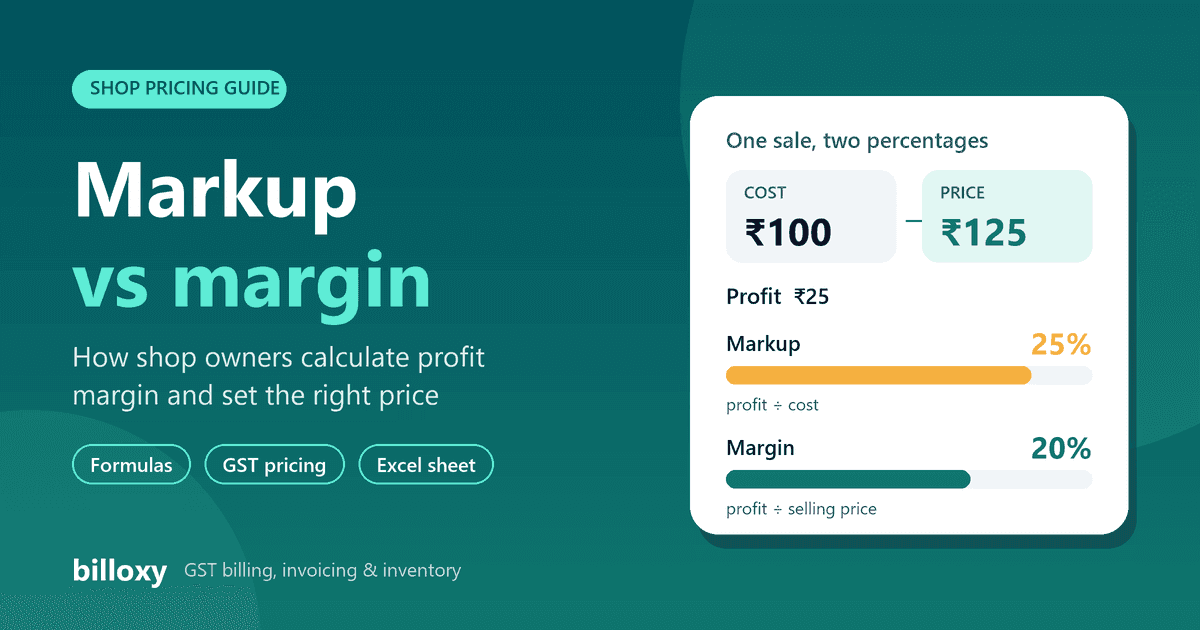
Markup is your profit as a percentage of what the item cost you. Margin is the same profit as a percentage of the price you sell it for. Buy at ₹100 and sell at ₹125: the profit is ₹25, the markup is 25%, and the margin is 20%. Mixing up the two is how shops end up earning less than they planned.
Price with the right numbers: check the GST part of any price with the free GST calculator, or start the 10-day free trial to keep sales and purchase prices for every item and see item-wise sales against purchases.
Updated 30 October 2026. This guide is for owners of kirana and grocery stores, medical shops, garment, hardware and mobile shops, and small wholesalers. It covers the formulas, a markup-to-margin table, how GST fits into your price, what a discount does to your profit, and a pricing sheet you can copy into Excel. All rupee figures are worked examples, not market rates. It is not tax or accounting advice.
What is the difference between markup and margin?
Both start from the same profit: selling price minus cost price. They differ only in what you divide that profit by.
| Markup | Margin | |
|---|---|---|
| Divides profit by | Cost price | Selling price |
| Formula | (Selling price − Cost) ÷ Cost × 100 | (Selling price − Cost) ÷ Selling price × 100 |
| Answers the question | "How much do I add on top of my cost?" | "How much of each sale do I keep?" |
| Example: cost ₹100, price ₹125 | 25% | 20% |
| Can it go above 100%? | Yes (cost ₹100, price ₹250 is a 150% markup) | No, it is always below 100% |
| Who usually uses it | Shop owners pricing goods, wholesalers quoting rates | Accountants, profit and loss statements, comparing items |
Because the selling price is always bigger than the cost when you make a profit, margin is always the smaller number. If you aim for a 25% margin but add only 25% to your cost, you actually earn a 20% margin.
The "profit percentage" taught in school maths, profit ÷ cost price × 100, is the same as markup.
How do you calculate profit margin?
Use these formulas. "Cost" means what you paid the supplier for one unit, and "price" means what you charge the customer for that unit, both before GST (see the GST section below).
| What you want | Formula | Example (cost ₹80, price ₹100) |
|---|---|---|
| Profit per unit | Price − Cost | ₹100 − ₹80 = ₹20 |
| Margin % | (Price − Cost) ÷ Price × 100 | 20 ÷ 100 × 100 = 20% |
| Markup % | (Price − Cost) ÷ Cost × 100 | 20 ÷ 80 × 100 = 25% |
| Price for a target margin | Cost ÷ (1 − margin) | 80 ÷ (1 − 0.20) = ₹100 |
| Price for a target markup | Cost × (1 + markup) | 80 × 1.25 = ₹100 |
| Margin from markup | Markup ÷ (1 + markup) | 0.25 ÷ 1.25 = 20% |
| Markup from margin | Margin ÷ (1 − margin) | 0.20 ÷ 0.80 = 25% |
The most useful line for a shop is price for a target margin. If you want to keep 30% of every sale on an item that costs ₹70, the price is 70 ÷ 0.70 = ₹100, not 70 × 1.30 = ₹91.
Markup to margin conversion table
Keep this table near the counter or in your pricing sheet.
| Markup on cost | Margin on price | Cost ₹100 sells at |
|---|---|---|
| 10% | 9.1% | ₹110 |
| 15% | 13.0% | ₹115 |
| 20% | 16.7% | ₹120 |
| 25% | 20.0% | ₹125 |
| 30% | 23.1% | ₹130 |
| 33.3% | 25.0% | ₹133.33 |
| 40% | 28.6% | ₹140 |
| 50% | 33.3% | ₹150 |
| 66.7% | 40.0% | ₹166.67 |
| 100% | 50.0% | ₹200 |
Read it both ways: a 50% markup gives a 33.3% margin, and a 25% margin needs a 33.3% markup.
Which one should a shop owner use?
Use markup when you price: it starts from the cost on your purchase bill, so it is quick to apply. Use margin when you check how the business is doing: your profit and loss statement, your rent, salaries and electricity are all measured against sales, not against cost.
The safe habit is to decide the margin you need first, then convert it to a markup for pricing. That way the number you plan with and the number you earn are the same.
Gross margin vs net margin: which margin pays the rent?
The margins above are gross margins: selling price minus the cost of the goods. Your shop also has running costs that do not belong to any one item.
| Gross margin | Net margin | |
|---|---|---|
| Formula | (Sales − Cost of goods sold) ÷ Sales × 100 | Net profit ÷ Sales × 100 |
| Takes out | Only what you paid for the goods you sold | Goods, plus rent, salaries, electricity, transport, interest and other expenses |
| Use it to | Price items and compare categories | See whether the whole shop is making money |
A shop can show a healthy gross margin on every bill and still make a loss if the running costs are larger than the gross profit. Our explainer on what a profit and loss statement shows walks through both lines, and profit vs cash flow explains why profit on paper is not the same as cash in the drawer.
How does GST fit into your selling price and margin?
GST is a tax you collect for the government, so for a regular GST-registered shop it is not part of your profit. Work out cost, price and margin before GST, then add GST on top.
Worked example (sample figures). You buy an item at ₹200 before GST and want a 25% margin. Say the item's GST rate is 18%.
- Price before GST = 200 ÷ (1 − 0.25) = ₹266.67
- GST at 18% = 266.67 × 0.18 = ₹48.00
- Price with GST = ₹314.67, so you round the shelf price to ₹315
- Check: ₹315 includes GST, so the price before GST is 315 ÷ 1.18 = ₹266.95, the profit is ₹66.95 and the margin is about 25.1%
The common mistake is to take the GST-inclusive price as your sale amount: ₹315 − ₹200 = ₹115 looks like a 36.5% margin, but ₹48 of it belongs to the government.
Two GST formulas for prices (sample rate r, written as a percentage):
- Price with GST = Price before GST × (100 + r) ÷ 100
- GST inside a GST-inclusive price = Inclusive price × r ÷ (100 + r)
The free GST calculator does both, for inclusive and exclusive amounts.
Purchase cost and input tax credit. If you are a regular registered dealer and can claim input tax credit on the purchase, use the purchase cost before GST. If you cannot claim the credit, for example on blocked items or if you are not registered, the GST you paid is part of your cost.
Composition dealers. Under section 10 of the CGST Act, a shop in the composition scheme cannot collect tax from customers and cannot take input tax credit. So the GST on your purchases is part of your cost, and the composition tax you pay comes out of your margin. Price with that in mind.
Printed MRP. For packaged goods with a printed MRP, treat the MRP as the ceiling and work backwards: take out the GST part first, then check what margin is left over your cost.
What does a discount do to your profit?
A discount comes straight out of your profit, not out of your cost, so a small discount can remove a large share of the profit.
| Before discount | After a 10% discount | |
|---|---|---|
| Cost (before GST) | ₹200 | ₹200 |
| Price (before GST) | ₹266.67 | ₹240.00 |
| Profit per unit | ₹66.67 | ₹40.00 |
| Margin | 25.0% | 16.7% |
The price fell by 10%, but the profit per unit fell by 40%. To earn the same total profit you now need to sell 66.67 ÷ 40 ≈ 1.67 times as many units, about 67% more. Before a festive or clearance discount, work out whether the extra sales can cover that. For old stock you cannot sell at all, a discount can still be the right call; see our guide to dead stock.
A pricing sheet you can copy into Excel
Set up one row per item. Enter the margin and GST rate as decimals (25% as 0.25, 18% as 0.18).
| Column | Heading | What to enter or the Excel formula (row 2) |
|---|---|---|
| A | Item | Item name or code |
| B | Cost before GST | From the purchase bill |
| C | Target margin | For example 0.25 |
| D | Price before GST | =B2/(1-C2) |
| E | GST rate | The item's rate, for example 0.18 |
| F | Price with GST | =D2*(1+E2) |
| G | Shelf price (rounded) | =ROUND(F2,0) or your own rounding |
| H | Actual margin | =(G2/(1+E2)-B2)/(G2/(1+E2)) |
| I | Markup | =(G2/(1+E2)-B2)/B2 |
Column H checks that rounding has not eaten your margin. If you are a composition dealer, put your GST-inclusive purchase cost in column B and leave column E at 0. Then remember to set aside the composition tax.
Five pricing mistakes small shops make
- Adding the margin percentage to the cost. A 20% "margin" added as 20% on cost is really a 16.7% margin.
- Counting GST as profit. Always compare prices and costs before GST.
- Pricing from an old purchase rate. When a supplier raises the rate, your margin shrinks on every sale until you update the price.
- Forgetting discounts, schemes and free items. Freebies and "buy 2 get 1" offers are price cuts and lower your margin like any discount.
- Looking only at gross margin. Check the net margin every month, after rent, salaries and other expenses.
How Billoxy helps you keep an eye on margins
Billoxy is AI-powered GST billing, invoicing, inventory and business-management software for Indian MSMEs. It does not choose your prices, but it keeps the numbers you need in one place:
- Sales and purchase price on every item. When you add an item, you set its sales price, purchase price, HSN/SAC code and GST rate, so invoices use the same figures every time.
- Item-wise sales against purchases. The Sales vs Purchase by Item report shows sales and purchase quantity and amount per item for any period, so you can spot items where pricing needs a follow-up, and export it to a spreadsheet.
- Sales, purchase and expense summaries. Reports cover sales, purchase and expense summaries for any period, which feed your gross and net margin checks.
- Ask about your reports. Billoxy's AI agents can answer questions about your business reports. You can try them in AI Chat.
Running a retail shop? See billing software for retail stores. To bill with saved prices and track item-wise sales and purchases, start the 10-day free trial or compare plans on pricing.
Questions shop owners ask about markup and margin
What is the difference between markup and margin in simple words?
Markup is how much you add to your cost, as a percentage of the cost. Margin is how much of the selling price you keep, as a percentage of the price. On the same sale the markup is always higher than the margin: cost ₹100 and price ₹125 is a 25% markup but a 20% margin.
How do I calculate profit margin for my shop?
Take the selling price before GST, subtract the cost price before GST, divide by the selling price and multiply by 100. For an item bought at ₹80 and sold at ₹100, the margin is (100 − 80) ÷ 100 × 100 = 20%.
How do I calculate the selling price from cost and margin?
Divide the cost by (1 − margin). For a ₹70 cost and a 30% margin, the price before GST is 70 ÷ 0.70 = ₹100. Then add GST at the item's rate to get the shelf price.
Is 25% markup the same as 25% margin?
No. A 25% markup gives a 20% margin. To earn a 25% margin you need a markup of about 33.3%.
Is profit percentage the same as profit margin?
Not usually. In school maths, profit percentage is profit divided by cost price, which is the same as markup. Profit margin divides the profit by the selling price, so it is the smaller number.
Should GST be included when calculating margin?
For a regular GST-registered shop, no. GST collected on a sale is owed to the government, so compare the price and the cost before GST. A composition dealer cannot claim input tax credit, so the GST paid on purchases is part of the cost.