
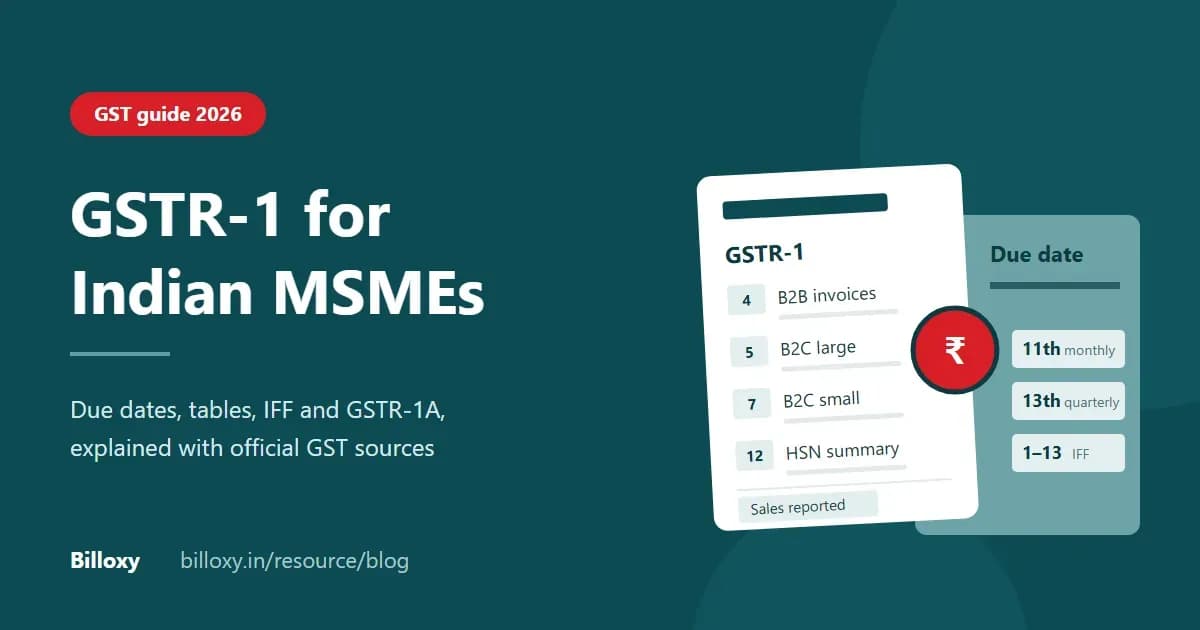
GSTR-1 is the statement of outward supplies in which a regular GST taxpayer reports the sales invoices, credit notes and debit notes it issued in a month or quarter. Monthly filers furnish it by the 11th of the next month. Businesses in the QRMP scheme file it quarterly, by the 13th of the month after the quarter.
Updated 20 October 2026. This guide explains GSTR-1 for small and medium businesses in plain words. It is not tax advice and not a click-by-click filing manual. Check the current form, advisories and any extension on the GST portal before you file, and ask your accountant about anything you are unsure of.
What is GSTR-1?
GSTR-1 is your sales statement for GST. The legal base is Section 37 of the CGST Act (furnishing details of outward supplies) and Rule 59 of the CGST Rules, which sets out what the form holds. GSTN's FAQ on Form GSTR-1 calls it a monthly or quarterly statement of outward supplies, furnished by normal and casual registered taxpayers.
It matters for two reasons:
- Your buyers' credit depends on it. The invoices you report flow into your registered customers' GSTR-2B, the statement from which they claim input tax credit. Our GSTR-2B guide shows that side.
- Your own tax payment follows it. The sales liability in your GSTR-3B is now auto-filled from GSTR-1 and cannot be edited there (more below).
GSTR-1 does not pay tax. You pay through GSTR-3B. Our article on the difference between GSTR-1 and GSTR-3B compares the two side by side.
| Return | What it holds | Role for a shop or MSME |
|---|---|---|
| GSTR-1 / IFF | Invoice-level sales, credit and debit notes, B2C summaries, HSN summary | Tells the portal and your buyers what you sold |
| GSTR-1A | Optional same-period corrections and missed records | Fixes GSTR-1 before you file GSTR-3B |
| GSTR-2B | Purchase ITC statement built from your suppliers' GSTR-1 | Shows the credit you may claim |
| GSTR-3B | Totals of tax, ITC, interest and late fee | Pays the net GST. See our GSTR-3B guide |
| GSTR-9 | Annual summary of the year | Year-end check. See our GSTR-9 guide |
Who has to file GSTR-1?
Every registered person making outward supplies files GSTR-1, except, as GSTN lists them:
- taxpayers under the composition scheme, who file GSTR-4 instead,
- non-resident foreign taxpayers,
- online information database access and retrieval (OIDAR) service providers,
- Input Service Distributors,
- TDS deductors and e-commerce operators collecting TCS.
Filing is mandatory even when there was no business in the period. A month or quarter with no sales still needs a nil GSTR-1.
What is the GSTR-1 due date?
| Filer | GSTR-1 due date | Source |
|---|---|---|
| Monthly | 11th of the next month | GSTN FAQ on Form GSTR-1 |
| Quarterly (QRMP) | 13th of the month after the quarter | GSTN FAQ on Form GSTR-1 |
| IFF (optional, QRMP filers, months 1 and 2 of a quarter) | From the 1st to the 13th of the next month | Rule 59(2) |
So the GSTR-1 for October 2026 is due by 11 November 2026 for a monthly filer, and the quarterly GSTR-1 for October–December 2026 is due by 13 January 2027, unless the Government extends the date by notification. Extensions do happen, so check the portal for the period you are filing.
Who can file GSTR-1 quarterly?
GSTN's QRMP FAQ says taxpayers with aggregate turnover at PAN level up to ₹5 crore in the preceding financial year can opt for quarterly GSTR-1 and GSTR-3B. A new registrant can opt in if it expects turnover within that limit. If you opt for quarterly filing, both returns move to quarterly, while tax is still paid monthly.
What is IFF in GST?
The Invoice Furnishing Facility (IFF) lets a quarterly filer upload B2B invoices, and credit or debit notes against them, for the first and second months of a quarter, so its buyers get their credit sooner. Rule 59(2) allows up to ₹50 lakh of invoice value in each month, uploaded between the 1st and 13th of the next month. IFF is optional. GSTN notes that the IFF for a month expires after the 13th, and anything not uploaded goes into the quarterly GSTR-1. Invoices already uploaded in IFF are not repeated in the quarterly return (Rule 59(3)).
What do you report in GSTR-1?
Rule 59(4) sets the core content. The portal groups it into tables:
| What you issued | Where it goes | How it is reported |
|---|---|---|
| Invoices to registered buyers (B2B), including SEZ supplies and deemed exports | Tables 4, 6B, 6C | Invoice by invoice, with the buyer's GSTIN |
| Inter-state invoices above ₹1 lakh to unregistered buyers (B2C large) | Table 5 | Invoice by invoice, with place of supply |
| Exports | Table 6A | Invoice by invoice |
| Other sales to unregistered buyers (B2C small) | Table 7 | Consolidated by rate, and by state for inter-state sales |
| Nil-rated, exempt and non-GST supplies | Table 8 | Totals |
| Amendments to earlier invoices, and credit notes and debit notes | Table 9 (9B for notes), Table 10 for B2C small amendments | Note by note for registered buyers and B2C large |
| Advances received for future supplies, and their later adjustment | Advances tables | Totals for the period |
| Supplies through e-commerce operators | Tables 14, 14A, 15 | As the portal asks |
| HSN-wise summary | Table 12 | Separate B2B and B2C tabs |
The B2C large limit dropped from ₹2.5 lakh to ₹1 lakh from 1 August 2024 (Notification No. 12/2024-Central Tax, as shown in Rule 59). Some older guides, and parts of the portal FAQ, still quote ₹2.5 lakh.
How do HSN codes work in Table 12?
Table 12 is the HSN or SAC summary of everything you sold. GSTN's FAQ says that from May 2025 it is split into B2B and B2C tabs, and that you pick codes from the portal's drop-down list rather than typing them. The minimum length depends on your aggregate annual turnover (AATO): 6 digits if it is above ₹5 crore, 4 digits if it is ₹5 crore or less. The portal warns you when the B2B tab does not match the B2B tables. Our guides to HSN codes and SAC codes explain the codes themselves.
Do e-invoices fill GSTR-1 automatically?
Partly. If you issue e-invoices, GSTN auto-populates B2B invoices (Tables 4A, 4B, 4C, 6B, 6C), export invoices (6A) and credit or debit notes (9B) from the e-invoice data. You can still edit them before filing. B2C small sales and the HSN summary still need your own figures.
A simple GSTR-1 example
A Pune trader registered in Maharashtra files monthly. Its turnover is below ₹5 crore. In October 2026 it issued:
| Document | Details | GSTR-1 table |
|---|---|---|
| Tax invoice to a registered retailer in Nashik | Taxable value ₹1,00,000 at 18%: ₹9,000 CGST + ₹9,000 SGST | Table 4A (B2B) |
| Tax invoice to an unregistered customer in Bengaluru | Invoice value ₹1,50,000 including IGST | Table 5 (B2C large: inter-state and above ₹1 lakh) |
| Counter sales to walk-in customers in Pune | ₹2,40,000 taxable value at 18% | Table 7 (B2C small, one line for that rate) |
| Credit note to the Nashik retailer for returned goods | ₹10,000 taxable value | Table 9B (registered) |
| HSN summary of all the above | 4-digit codes, B2B and B2C tabs | Table 12 |
The Bengaluru invoice carries IGST because the place of supply is in Karnataka. The GST state code on that invoice is 29, not Maharashtra's 27. A wrong state on an invoice puts it in the wrong table and the wrong tax type, which our CGST, SGST and IGST guide explains.
Why GSTR-1 accuracy now decides your GSTR-3B
GSTN's advisory of 7 June 2025 says that from the July 2025 tax period, the liability auto-populated in GSTR-3B from GSTR-1, GSTR-1A or IFF is non-editable (GSTN advisory). So a mistake in GSTR-1 is no longer fixed quietly in GSTR-3B. It must be corrected in GSTR-1A before GSTR-3B is filed, or amended in a later GSTR-1.
The filing order is also locked:
- You cannot file GSTR-3B for a period until GSTR-1 for that period is filed (Section 39(10), as GSTN's FAQ explains).
- You cannot file GSTR-1 if an earlier period's GSTR-1 is pending (Section 37(4)).
- You cannot file GSTR-1 if the GSTR-3B for the previous period is not filed (Rule 59(6)), or if you have not added bank account details to your registration as Rule 10A requires (Rule 59(6)(f)).
What is GSTR-1A?
GSTR-1A is an optional form to correct or add to the GSTR-1 of the same tax period. The proviso to Rule 59(1), added by Notification No. 12/2024-Central Tax, allows it after you furnish GSTR-1 and before you file GSTR-3B for that period. GSTN's FAQ adds that:
- it opens after GSTR-1 is filed or its due date passes, whichever is later,
- it can be filed only once per tax period,
- its changes auto-populate in your GSTR-3B,
- your buyers see the ITC for records added or amended through GSTR-1A in their next period's GSTR-2B.
Can I revise GSTR-1 after filing?
There is no revised GSTR-1. You correct a filed invoice through amendment tables in a later GSTR-1 (or through GSTR-1A, if GSTR-3B for that period is not yet filed). Two limits apply:
- Amendment cut-off. Errors in a financial year's details cannot be corrected after 30 November following the end of that year, or after the annual return is furnished, whichever is earlier (Section 37(3)). For FY 2025-26 that means 30 November 2026 at the latest.
- Three-year bar. From 1 October 2023, GSTR-1 cannot be filed after three years from its due date (Section 37(5); GSTN advisory on barring of returns).
GSTR-1 late fee
Section 47 of the CGST Act charges a late fee of ₹100 for every day the details stay unfiled, up to ₹5,000, under that Act. The amount actually charged can be lower where the Government has waived part of it by notification, so rely on the late fee the portal computes for your return. For how late fees work across GST returns, see penalty for late GST filing. Missing the due date also triggers a system-generated return-defaulter notice (Form GSTR-3A), and it blocks your GSTR-3B for that period.
How do I file a nil GSTR-1?
If you had no outward supplies (including reverse-charge, zero-rated supplies and deemed exports), no amendments, no credit or debit notes and no advances to report, you can file a nil GSTR-1 on the portal or by SMS. GSTN's nil GSTR-1 SMS FAQ gives the format: send NIL R1 [GSTIN] [period as MMYYYY] to 14409 from the authorised signatory's registered mobile number. A quarterly filer uses the quarter's last month (for example 122026 for October–December 2026). Then confirm with CNF R1 [code]. The code is valid for 30 minutes. SMS filing works only if no GSTR-1 data is saved for that period on the portal.
Before you file GSTR-1: a monthly checklist
- Check every buyer GSTIN. GSTN says the portal rejects an invoice if the buyer's GSTIN was not active on the invoice date.
- Check invoice numbers. Up to 16 characters, letters and numbers with only dash and slash, and no duplicate series in a financial year.
- Split B2C sales into inter-state invoices above ₹1 lakh (Table 5) and the rest (Table 7, by rate and state).
- Match HSN totals in Table 12 with your sales register, separately for B2B and B2C.
- Include credit and debit notes issued in the period.
- File before GSTR-3B, and use GSTR-1A for any same-period fix.
How Billoxy fits in
Billoxy is AI-powered GST billing, invoicing, inventory and business-management software for Indian MSMEs. Every sale invoice carries the buyer's GSTIN, HSN or SAC, tax rate and state, so CGST, SGST and IGST are split as you bill. From Reports → GSTR you can create a GSTR-1 (or GSTR-3B or GSTR-4) for a period, generate it from that period's invoices and GST data, and download the file, as described on the GST & GSTR feature page. Billoxy does not file GSTR-1 on the GST portal or replace your accountant's review. You still complete filing on the portal. What it does is keep the period's sales records consistent, so the statement starts from clean data.
To keep your GST invoices and return data in order, start the 10-day trial or compare plans on pricing.
Questions MSMEs ask about GSTR-1
What is the full form of GSTR-1?
GSTR stands for Goods and Services Tax Return. Form GSTR-1 is the statement of outward supplies under Section 37 of the CGST Act and Rule 59 of the CGST Rules.
Is GSTR-1 for sales or purchases?
Sales. GSTR-1 reports your outward supplies. Purchases appear in GSTR-2B, which the portal builds from your suppliers' GSTR-1 filings.
Do I have to file GSTR-1 if I had no sales?
Yes, if you are a normal or casual taxpayer. File a nil GSTR-1, on the portal or by SMS to 14409.
Can I file GSTR-3B before GSTR-1?
No. GSTR-3B for a period cannot be filed until GSTR-1 for that period is filed, and the sales liability in GSTR-3B is taken from GSTR-1.
What is the difference between GSTR-1 and GSTR-1A?
GSTR-1 is the main statement. GSTR-1A is an optional, once-a-period form to correct or add records to that GSTR-1 before you file GSTR-3B.
Did the 57th GST Council change GSTR-1?
The Council's 8 October 2026 meeting recommended several compliance and relief measures, including a late-fee waiver for smaller taxpayers. Recommendations take effect only through notifications, circulars and law amendments, so the rules above apply until those are issued. Check the 57th GST Council press release and the GST portal for updates.
Official sources
- FAQs on Form GSTR-1 and GSTR-1A — GST portal tutorial
- Section 37, CGST Act 2017 — CBIC tax information portal
- Section 47, CGST Act 2017 (late fee) — CBIC tax information portal
- Rule 59, CGST Rules 2017 — CBIC tax information portal
- FAQs on the QRMP scheme and IFF — GSTN
- Filing nil Form GSTR-1 through SMS — GST portal tutorial
- Advisory on non-editable auto-populated liability in GSTR-3B — GSTN, 7 June 2025
- Barring of GST returns on expiry of three years — GSTN, 29 October 2024