
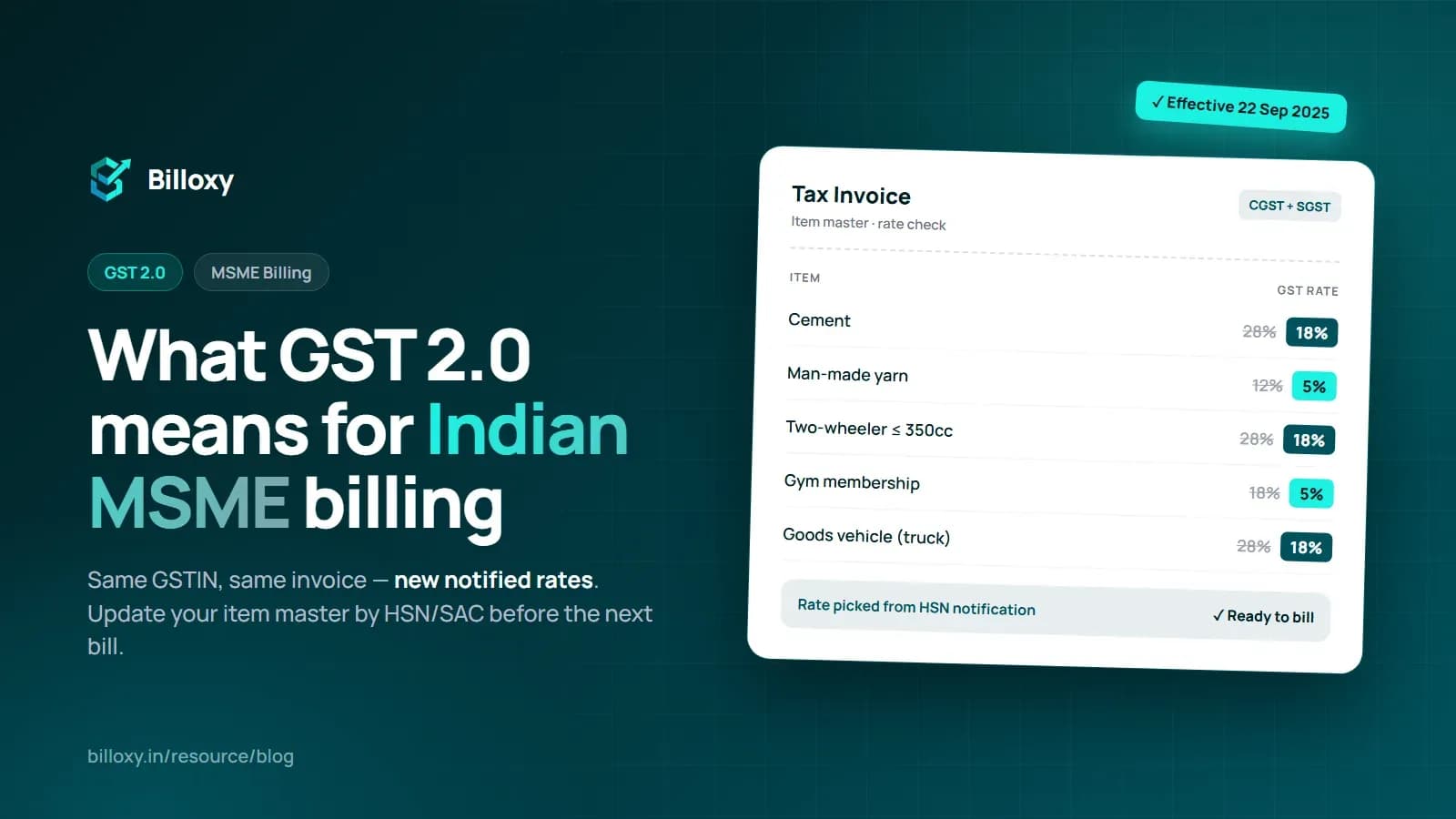
GST 2.0 is the September 2025 reform of India's goods and services tax rates. The revised rates took effect on 22 September 2025. It is not a new tax, and it does not give you a new GSTIN. For a shop, trader, or small manufacturer, the job is narrower: bill the notified rate for each item, and stop using a rate that belonged to the old slab.
This note is updated 7 October 2026. It explains what an MSME should check on the next invoice. It is not a complete rate schedule, and it is not tax advice. Confirm the notification for your HSN or SAC on the GST Council and CBIC GST pages before you bill.
What GST 2.0 is
The Government of India described the September 2025 changes as GST reforms for a new generation. The Press Information Bureau factsheet of 20 September 2025 is the public summary: rates were cut on many everyday and MSME goods, some education items became nil-rated, individual health insurance was exempted, and specified tobacco products moved to a higher rate.
Searchers often call the whole package GST 2.0. News sites also call the same package "new GST rates". Those are related phrases, not two different laws. The rate list itself lives on official notifications. A 2025 news roundup is a starting point, not the rate you should type into an invoice in 2026.
What changed for the rates you type on an invoice
The practical change is the percentage stored against the item.
The PIB factsheet states, among other moves:
- Many goods that sat at 12% were brought down, often to 5% or to nil.
- Many goods that sat at 28% were brought down to 18%, including cement, small cars, two-wheelers up to 350cc, and commercial goods vehicles.
- Specified tobacco and tobacco-substitute products moved from 28% to 40%.
- Individual health insurance was exempted.
- School and university education stayed exempt. Several learning items, including pencils, exercise books, and erasers, were made nil-rated.
CGST and SGST still apply together on a normal intra-state taxable supply. IGST still applies on a normal inter-state taxable supply. GST 2.0 changed how much tax many items attract. It did not replace that split. The difference between CGST, SGST, and IGST is the page for that question.
What did not change
Keep these rules separate from the rate reform. Mixing them is how invoices go wrong.
- A GST invoice still needs the fields the law already requires, including the rate you actually charge.
- The HSN or SAC on the line still decides which notification you look up. A lower slab for "footwear" does not automatically apply to every product in the shop.
- E-invoicing still depends on its own turnover notifications. GST 2.0 did not replace that test.
- An e-way bill is still about moving goods. The rate reform did not replace the movement rules.
- Input tax credit still follows the ITC conditions. A lower output rate does not, by itself, cancel credit you were allowed on inputs.
- Billoxy does not file your GST return and does not replace your chartered accountant.
What to update before the next invoice
Work through the item master, not a headline.
- List the goods and services you actually sell. Group them by HSN or SAC, not by the old habit of "12% items" and "28% items".
- Look up the current notified rate for each code. Use the GST Council or CBIC notification, not a screenshot from September 2025 social media.
- Replace the rate on the item in your billing records. The invoice should pick up that rate. Do not leave 12% or 28% on a line whose notification has moved.
- Check price display. If the shelf price included the old tax, decide with your accountant whether the selling price should change so the customer sees the new tax, not a silent margin change.
- Check side lines. Packaging, job-work, freight, and insurance of goods carriages were called out in the factsheet. A carton or a job-work charge can move even when the finished product's rate looks familiar.
- Split the tax the same way as before. Intra-state: CGST + SGST. Inter-state: IGST. The percentages of CGST and SGST are halves of the item's GST rate only when that is how the notification works for a normal domestic supply. Unusual supplies still need the rule that applies to them.
If you issue a tax invoice at the wrong rate after 22 September 2025, correct that document. A credit note is the usual way to reduce the taxable value or tax already charged. Which document fits your case is a question for your accountant. This article does not set a time limit.
Examples the official factsheet actually states
The table is a short set of examples from the PIB factsheet dated 20 September 2025. It is not the full GST schedule. Rates and thresholds can be amended. Confirm the line that matches your HSN or SAC before you save it on an item.
| Supply, as described by PIB | Rate change PIB stated |
|---|---|
| Footwear priced up to ₹2,500 a pair | 5% GST |
| Ready-made apparel up to ₹2,500 a piece (the earlier apparel threshold was ₹1,000) | 5% GST |
| Man-made fibre | 18% to 5% |
| Man-made yarn | 12% to 5% |
| Packing paper, cartons, and paper-board boxes | 5% GST |
| Commercial goods vehicles (trucks, delivery vans) | 28% to 18% |
| Cement | 28% to 18% |
| Two-wheelers up to 350cc, and small cars as described in the factsheet | 28% to 18% |
| Gyms and fitness centres | 18% to 5% |
| Drugs and medicines, as grouped in the factsheet | 12% to 5% or nil |
| Individual health insurance | Exempt |
| Pencils, exercise books, and related learning items called out in the factsheet | Nil |
| Specified tobacco and tobacco-substitute products | 28% to 40% |
| Paratha, parotta, and roti, described as staple Indian breads | Exempt |
A pharmacy, a garment shop, a footwear retailer, and a workshop can all be in this table and still need different rates on different lines. "Medicines moved" does not mean every SKU on the shelf is 5%.
How this shows up in billing software
Billing software does not look up today's notification for you. It applies the rate saved on the item, then splits that rate into CGST and SGST or IGST from the place of supply on the invoice.
That is the useful check:
- One current rate per item you sell.
- HSN or SAC filled in, so the next person can see why the rate is there.
- A tax invoice your customer can use, with the rate that was actually charged.
Billoxy is GST billing, invoicing, inventory, and business-management software for Indian MSMEs. You set the GST rate on the item; the invoice uses it. The software offer is a 10-day trial. Creating an invoice in Billoxy is built to take under five seconds once the item and party are already saved — that speed does not choose the legal rate.
If you only need one invoice and you do not want an account, the GST invoice generator is a no-signup builder with GST fields. It is not the billing product, and it does not store a rate master for your whole catalogue. Shops that bill every day should keep rates on the items inside the product, then start the 10-day trial or compare plans on pricing.
Questions MSMEs ask
When did GST 2.0 start?
The revised rates took effect on 22 September 2025. The PIB factsheet explaining the package is dated 20 September 2025.
Is GST 2.0 a new registration or a new return?
No. You keep the same GSTIN. GSTR-1 and GSTR-3B were not replaced by this rate reform. You still report the supplies you made, at the rate you actually charged.
Should I change every item to 5%?
No. 5% is one of the rates used for many goods that moved down. Other supplies stayed at 18%, some became nil or exempt, and specified tobacco products moved to 40%. Match the notification to the HSN or SAC.
Where is the full rate list?
Use the GST Council and CBIC notifications, and the GST portal. Do not treat a blog — including this one — as the rate master.
Did GST 2.0 change e-invoice or e-way bill limits?
Those limits sit in their own rules. Read the e-invoicing guide for MSMEs and what an e-way bill is. Do not assume a rate cut changed either threshold.
Will Billoxy file GST 2.0 returns for me?
No. Billoxy helps you raise GST invoices and keep item rates, stock, and business records. Returns are filed on the GST portal. Nothing here is a filing service or a guarantee of compliance.
Official sources
- GST reforms for a new generation — Press Information Bureau factsheet, 20 September 2025
- GST Council — rate notifications and Council material
- CBIC GST — central GST law and notifications
- GST portal — registration, returns, and taxpayer services