
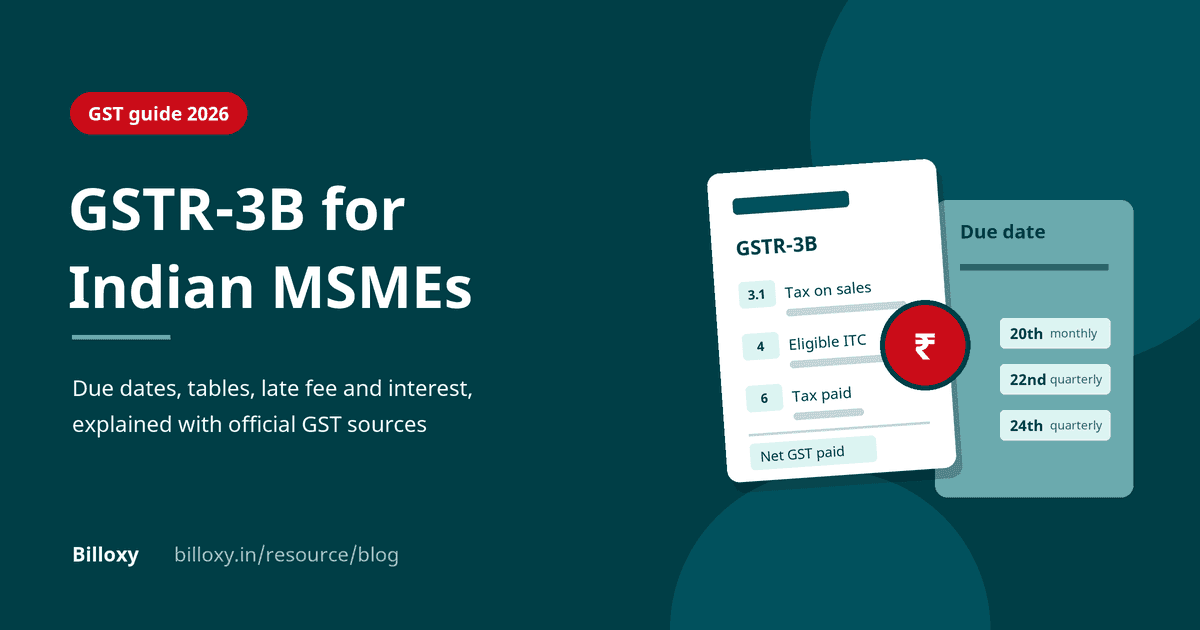
GSTR-3B is the summary GST return in which a regular taxpayer declares sales, reverse-charge purchases and eligible input tax credit (ITC) for a period, and pays the net GST. Monthly filers file it by the 20th of the next month. Small businesses under the QRMP scheme file it quarterly, by the 22nd or 24th depending on their state.
Updated 16 October 2026. This guide explains GSTR-3B for small and medium businesses in plain words. It is not tax advice and not a step-by-step filing manual. Check current forms, advisories and any extension on the GST portal before you file, and ask your accountant about anything you are unsure of.
What is GSTR-3B?
GSTR-3B is your tax payment return. The GST portal describes it as a summary of outward supplies, inward supplies liable to reverse charge, eligible ITC and tax paid (GSTN FAQ on Form GSTR-3B). The legal base is Section 39 of the CGST Act and Rule 61 of the CGST Rules.
It is not an invoice list. Invoice-level sales go in GSTR-1. GSTR-3B carries the totals and is the return through which you actually pay. Our article on the difference between GSTR-1 and GSTR-3B compares the two side by side.
| Return | What it holds | Role for a shop or MSME |
|---|---|---|
| GSTR-1 / IFF | Invoice-level sales, credit and debit notes | Tells the portal and your buyers what you sold |
| GSTR-2B | Purchase ITC statement built from your suppliers' filings | Shows the credit you may claim. See our GSTR-2B guide |
| GSTR-3B | Totals of sales tax, reverse-charge tax, ITC, interest and late fee | Pays the net GST for the period |
| GSTR-9 | Annual summary of the year's GSTR-1 and GSTR-3B | Year-end check. See our GSTR-9 guide |
Who has to file GSTR-3B?
Rule 61(1) requires every registered person to file GSTR-3B except:
- composition taxpayers (Section 10), who file under the composition scheme instead,
- Input Service Distributors,
- non-resident taxable persons,
- OIDAR service suppliers covered by Section 14 of the IGST Act,
- TDS deductors (Section 51) and TCS collectors (Section 52).
The GSTN FAQ adds that filing is mandatory for all normal and casual taxpayers, even if there was no business in that tax period. A month with no sales still needs a GSTR-3B, filed as a nil return.
What is the GSTR-3B due date?
The due date depends on whether you file monthly or quarterly.
| Filing frequency | GSTR-3B due date | Source |
|---|---|---|
| Monthly | 20th of the next month | Rule 61(1)(i) |
| Quarterly (QRMP), principal place of business in Chhattisgarh, Madhya Pradesh, Gujarat, Maharashtra, Karnataka, Goa, Kerala, Tamil Nadu, Telangana, Andhra Pradesh, Daman and Diu and Dadra and Nagar Haveli, Puducherry, Andaman and Nicobar Islands or Lakshadweep | 22nd of the month after the quarter | Rule 61(1)(ii), Table S. No. 1 |
| Quarterly (QRMP), principal place of business in Himachal Pradesh, Punjab, Uttarakhand, Haryana, Rajasthan, Uttar Pradesh, Bihar, Sikkim, Arunachal Pradesh, Nagaland, Manipur, Mizoram, Tripura, Meghalaya, Assam, West Bengal, Jharkhand, Odisha, Jammu and Kashmir, Ladakh, Chandigarh or Delhi | 24th of the month after the quarter | Rule 61(1)(ii), Table S. No. 2 |
The Government can extend these dates by notification. When it does, searches for "GSTR-3B due date" spike, so always check the portal for the period you are filing.
Does a quarterly filer pay tax only once a quarter?
No. QRMP means quarterly return, monthly payment. GSTN's QRMP FAQ says taxpayers with aggregate turnover at PAN level up to ₹5 crore can opt for quarterly GSTR-1 and GSTR-3B. For the first two months of each quarter, you pay tax through challan PMT-06 by the 25th of the next month (Rule 61(3)). You can use the portal's pre-filled fixed-sum challan or pay your self-assessed tax. The quarterly GSTR-3B then settles the full quarter.
What does GSTR-3B contain?
The tables are short, but each one draws on a different part of your books.
| Table | What it covers | Where the portal pre-fills it from | Records to keep ready |
|---|---|---|---|
| 3.1 (a, b, c, e) | Outward taxable supplies, zero-rated, nil-rated, exempt and non-GST supplies | GSTR-1 / GSTR-1A / IFF | Sales register by tax rate |
| 3.1 (d) | Inward supplies liable to reverse charge | GSTR-2B | Reverse charge purchase bills |
| 3.1.1 | Supplies through e-commerce operators under Section 9(5) | GSTR-1 / GSTR-1A (Tables 14 and 15) | E-commerce sales reports |
| 3.2 | Inter-state supplies to unregistered persons, composition taxpayers and UIN holders, by state | GSTR-1 / GSTR-1A | Place of supply on each B2C inter-state invoice |
| 4 | Eligible ITC, ITC reversed and net ITC | GSTR-2B (parts of 4A and 4D) | Purchase register matched with GSTR-2B |
| 5 | Exempt, nil-rated and non-GST inward supplies | — | Purchase bills without GST |
| 5.1 | Interest and late fee | System-computed interest from earlier periods | Dates you paid and filed late |
| 6 | Payment of tax, through ITC and cash | Your offset of liability | Electronic cash and credit ledger balances |
Can I edit the auto-filled sales tax in GSTR-3B?
Not any more, for the tax liability that comes from your sales returns. GSTN's advisory of 7 June 2025 says that from the July 2025 tax period (filed in August 2025), liability auto-populated from GSTR-1, GSTR-1A or IFF is non-editable in GSTR-3B (GSTN advisory). If a sale was reported wrongly, correct it through GSTR-1A for the same period, before you file GSTR-3B.
In practice, that makes GSTR-1 accuracy the real control point. A wrong GSTIN, rate or place of supply on an invoice flows straight into the tax you pay.
A simple GSTR-3B example
A Maharashtra trader files monthly. In one month it sells goods worth ₹5,00,000 taxable value to buyers in Maharashtra at 18% GST, so its sales tax is ₹45,000 CGST + ₹45,000 SGST. Its GSTR-2B for the month shows eligible ITC of ₹30,000 CGST + ₹30,000 SGST on purchases it has received and recorded.
| Line | CGST (₹) | SGST (₹) |
|---|---|---|
| Tax on outward supplies (Table 3.1(a), from GSTR-1) | 45,000 | 45,000 |
| Eligible ITC (Table 4, matched with GSTR-2B) | 30,000 | 30,000 |
| Net tax paid in cash (Table 6) | 15,000 | 15,000 |
If the same trader also sold to a buyer in Gujarat, that sale would carry IGST, not CGST and SGST. Our CGST, SGST and IGST guide explains why. ITC set-off has its own order of use, so let your accountant or the portal's offset screen apply it.
GSTR-3B late fee and interest
Late fee
The GSTN filing guide states the late fee for a delayed GSTR-3B as ₹25 per day under each Act (CGST and SGST) when there is tax liability, or ₹10 per day under each Act for a nil return. There is no late fee under IGST or cess.
Since the June 2021 tax period, Notification No. 19/2021-Central Tax caps the late fee for these classes, as GSTN lists them:
| Class of registered person | Late fee waived above (₹) |
|---|---|
| Total CGST and SGST/UTGST payable in the return is nil | 500 |
| Aggregate turnover up to ₹1.5 crore in the preceding financial year | 2,000 |
| Aggregate turnover above ₹1.5 crore and up to ₹5 crore | 5,000 |
For late fees across other returns, see penalty for late GST filing.
Interest
Interest on tax paid late is charged under Section 50 of the CGST Act and shows in Table 5.1 of a later GSTR-3B. GSTN's advisory on interest collection says that from the January 2026 tax period:
- the portal computes interest only on the net tax liability minus the minimum cash balance you held in the electronic cash ledger from the due date until the tax was debited (Rule 88B(1)), so cash you had already deposited on time reduces interest;
- the system-computed interest in Table 5.1 is the minimum you must pay. You cannot edit it downward, but you must increase it if your own calculation is higher.
Can I revise GSTR-3B after filing?
No. The GSTN FAQ says a filed GSTR-3B cannot be revised. You correct an error, such as missed sales or extra ITC, in the return of a later period, with interest if tax was short-paid.
There is also an outer limit. From 1 October 2023 (Notification No. 28/2023-Central Tax, under the Finance Act 2023), a return under Section 39 cannot be filed after three years from its due date. GSTN's advisory of 29 October 2024 applies this to GSTR-3B along with GSTR-1, GSTR-4 and GSTR-9. An old unfiled GSTR-3B is therefore worth clearing now, not later.
How do I file a nil GSTR-3B?
If you had no sales, no reverse-charge purchases, no ITC to claim and no pending interest or late fee, you can file a nil GSTR-3B on the portal or by SMS. GSTN's nil filing FAQ gives the format: send NIL 3B [your GSTIN] [return period as MMYYYY] to 14409 from the authorised signatory's registered mobile number, then confirm with the code you receive (CNF 3B [code]). SMS filing works only when all earlier GSTR-3B returns are filed and no data is saved in the online form for that period.
Before you file GSTR-3B: a monthly checklist
- File GSTR-1 or IFF first, and fix any wrong sale through GSTR-1A. GSTR-3B liability now follows it.
- Total your sales register by tax rate and by intra-state and inter-state supply.
- Match your purchase register with GSTR-2B and claim only eligible ITC. Our guide on claiming input tax credit covers the conditions.
- List reverse-charge purchases for Table 3.1(d).
- Check Table 5.1 for interest carried from late payments.
- Pay the net cash liability and file before the due date. There is no revision.
How Billoxy fits in
Billoxy is AI-powered GST billing, invoicing, inventory and business-management software for Indian MSMEs. Every sale and purchase invoice carries GSTIN, HSN or SAC, tax rate and state, so CGST, SGST and IGST are split as you bill. From Reports → GSTR you can create a GSTR-3B (or GSTR-1 or GSTR-4) for a period, generate it and download the file, as described on the GST & GSTR feature page. Billoxy does not file GSTR-3B on the GST portal, pay your tax or replace your accountant's review. It keeps the month's sales and purchase records in one place, so the return starts from clean data.
To keep your GST invoices and returns data in order, start the 10-day trial or compare plans on pricing.
Questions MSMEs ask about GSTR-3B
What is the full form of GSTR-3B?
GSTR stands for Goods and Services Tax Return. Form GSTR-3B is the monthly or quarterly summary return under Rule 61 of the CGST Rules.
Do I have to file GSTR-3B if I had no sales?
Yes, if you are a normal or casual taxpayer. The GSTN FAQ says GSTR-3B is mandatory even with no business in the period. File a nil return, on the portal or by SMS to 14409.
Is GSTR-3B the same as GSTR-1?
No. GSTR-1 reports invoice-level sales. GSTR-3B reports totals and pays the tax. Since the July 2025 tax period, the sales liability in GSTR-3B is taken from GSTR-1, GSTR-1A or IFF and cannot be edited in GSTR-3B.
Can I claim ITC in GSTR-3B that is not in GSTR-2B?
ITC is claimed in Table 4 of GSTR-3B, subject to the conditions in Section 16 of the CGST Act. Table 4 is pre-filled from GSTR-2B. Read input tax credit in GST and check any claim outside GSTR-2B with your accountant.
What happens if I miss the GSTR-3B due date?
You pay a late fee per day (capped for smaller taxpayers, as in the table above) and interest on the tax paid late. After three years from the due date, the return can no longer be filed at all.
Did the 57th GST Council change GSTR-3B?
The Council's 8 October 2026 meeting recommended several compliance and relief measures for small taxpayers. Recommendations take effect only through notifications, circulars and law amendments, so the rules above apply until those are issued. Check the 57th GST Council press release and the GST portal for updates.
Official sources
- FAQs on Form GSTR-3B — GST portal tutorial
- Rule 61, CGST Rules 2017 — CBIC tax information portal
- Advisory on non-editable auto-populated liability in GSTR-3B — GSTN, 7 June 2025
- Advisory on interest collection and related enhancements in GSTR-3B — GSTN
- Barring of GST returns on expiry of three years — GSTN, 29 October 2024
- FAQs on the QRMP scheme — GSTN
- Filing nil Form GSTR-3B through SMS — GST portal tutorial
- New functionalities, July–September 2021 (late fee caps under Notification No. 19/2021-CT) — GSTN