
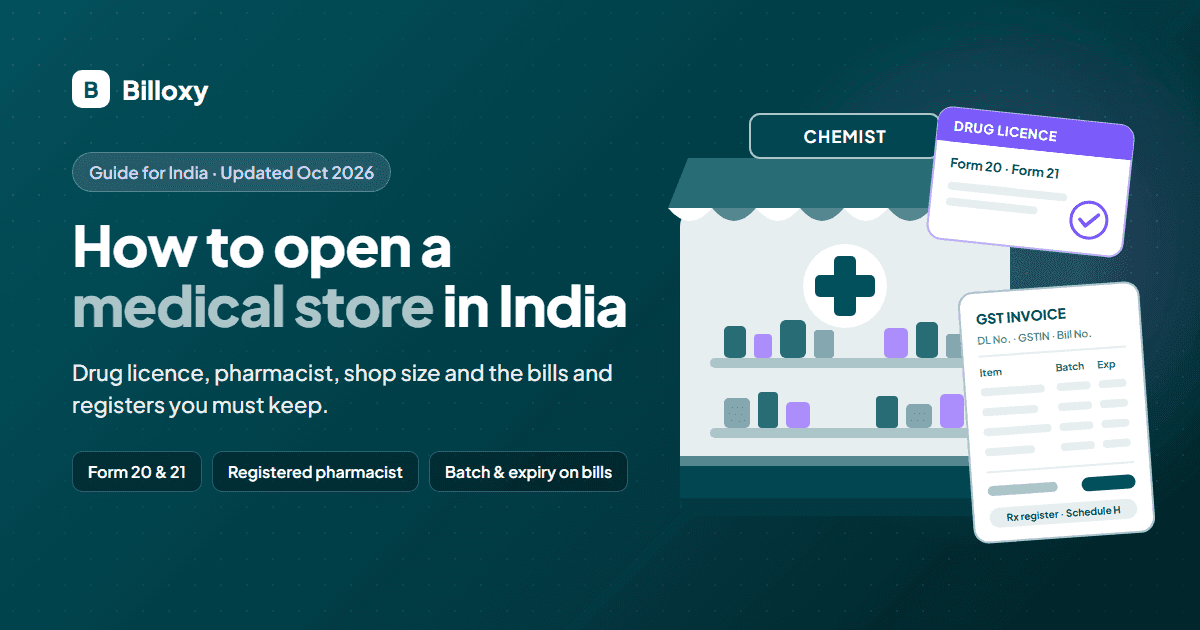
To open a medical store in India you need a retail drug licence from your state's drugs control department (Form 20 and/or Form 21, applied for on Form 19), shop premises of at least 10 square metres with proper storage, and a registered pharmacist to supervise sales on prescription. After that come GST and local registrations, and bills and records that meet the Drugs Rules.
Updated 26 October 2026. This guide is for people starting a retail chemist or pharmacy, and for shop owners adding medicines to an existing store. It follows the Drugs Rules, 1945 as published by the Central Drugs Standard Control Organisation (CDSCO). Licences are issued by each state, and states add their own forms, fees and checklists. Always check your state drugs control department before you apply. This is not legal advice.
What licences do you need to open a medical store?
A medical store sells drugs, so the main licence comes under the Drugs and Cosmetics Act, 1940 and the Drugs Rules, 1945. Rule 61 sets out which licence form covers which drugs:
| Licence | What it allows | Applied for on |
|---|---|---|
| Form 20 | Retail sale of drugs other than those in Schedules C, C(1) and X | Form 19 |
| Form 21 | Retail sale of drugs in Schedules C and C(1) (for example many biological products) | Form 19 |
| Form 20B / 21B | Wholesale of the same two groups | Form 19 |
| Form 20A / 21A | "Restricted" retail licence for drugs whose sale does not need a qualified person, issued at the licensing authority's discretion | Form 19A |
| Form 20F / 20G | Retail / wholesale of drugs in Schedule X | Form 19C |
Most new chemist shops apply for Form 20 and Form 21 together, so they can sell the full range of allopathic medicines by retail. If you also plan to supply other shops, clinics or hospitals, you need the wholesale licences (20B and 21B) as well. Homoeopathic medicines have separate licences (Form 20C and 20D in Delhi's guidelines).
Two more points from the Rules matter when you plan:
- One licence per shop. Rule 62 says that if you sell or stock drugs at more than one place, each place needs its own application and licence. A second branch means a second licence.
- The licence stays valid if you pay the retention fee. Under Rule 63, a sale licence remains valid as long as the licensee pays a licence retention fee (equal to the licence fee) before the end of every five years from issue. Late payment carries a late fee of 2% of the licence fee per month for up to six months; after that the licence is deemed cancelled.
Who can run a medical store? The pharmacist requirement
You do not have to be a pharmacist to own a medical store. But the store must be run by someone the licensing authority accepts as competent, and certain jobs must be done by a registered pharmacist:
- Retail licence (Form 20 / 21): Rule 65 says any drug supplied on a doctor's prescription must be supplied by, or under the personal supervision of, a registered pharmacist. Any medicine compounded on the premises must also be made under a registered pharmacist's supervision. In practice, a chemist shop needs a registered pharmacist working there full time.
- Wholesale licence (Form 20B / 21B): Rule 64 accepts a competent person who is a registered pharmacist, or who has passed matriculation with four years' experience in selling drugs, or who holds a university degree with one year's experience in dealing with drugs.
State checklists ask for the pharmacist's registration details and an affidavit or consent from the pharmacist, so settle who your pharmacist is before you apply.
Rule 65 also controls the name on your board. A shop with a registered pharmacist that does not compound medicines displays "Chemists and Druggists". Only a shop that employs a registered pharmacist and keeps a pharmacy for compounding prescriptions may use "Pharmacy", "Pharmacist" or "Dispensing Chemist". A licensee who does not need a pharmacist displays "Drugstore".
What are the shop and storage requirements?
Rule 64 sets the minimum premises before a licence is granted:
| Requirement | What the Rules say |
|---|---|
| Area for retail (Form 20 / 21) | Not less than 10 square metres |
| Area for wholesale (Form 20B / 21B) | Not less than 10 square metres |
| Area for retail and wholesale together | Not less than 15 square metres |
| Storage | Premises must be adequate and have proper storage to preserve the drugs. A shop calling itself a pharmacy must also meet Schedule N |
| Schedule X drugs | Kept under lock and key in a cupboard or drawer used only for them, or in a separate part of the premises with restricted access (Rule 65) |
State checklists turn "proper storage" into documents. Tamil Nadu's checklist, for example, asks for a blueprint of the premises signed by a licensed engineer and the purchase bill for a refrigerator or air conditioner. Plan the cold storage for vaccines, insulin and other temperature-sensitive medicines before the drug inspector visits.
How do you apply for a drug licence, step by step?
The steps are similar in every state, though the portal and checklist differ:
- Fix the premises. Rent or buy a shop that meets the area rule, and get the rent agreement or ownership papers in order. Many states want the agreement to cover the licence period.
- Fix the business structure. Proprietorship, partnership, LLP or company. The licence is issued to that entity, and a change of constitution later needs a fresh licence in many states.
- Appoint the pharmacist or competent person, and collect their registration and consent papers.
- Apply to the state licensing authority. Rule 59 says the State Government appoints the licensing authority. Many states take applications online: Delhi's guidelines direct applicants to the XLN portal (xlnindia.gov.in), and Uttar Pradesh uses its FSDA online licensing site. Form 19 under Rule 59 carries a fee of ₹1,500 in the CDSCO text of the Rules (₹500 for Form 19A), so Form 20 and 21 together usually means ₹3,000. Tamil Nadu's fee table follows this. Check your state's current fee before you pay.
- Upload the documents. Typical lists include the application form, fee receipt, site plan and key plan, proof of constitution, proof of premises, pharmacist documents, the owner's identity and address proof, and refrigerator purchase proof. Rule 64 also lets the authority consider what business the applicant carried on in the previous three years, so some states ask for a declaration of that too.
- Inspection. A drugs inspector checks the premises, storage and original documents.
- Licence issued. Display it in the shop, put the licence number on every bill (see below) and diary the five-year retention fee.
If the application is refused, Rule 64 allows an appeal to the State Government within 30 days of receiving the order.
Which other registrations does a new medical store need?
The drug licence is the one only medical stores need. These apply to most shops:
- GST registration. Required once your turnover crosses the threshold for your state, and earlier in some cases (for example if you make inter-state supplies of goods). Once registered, you issue GST invoices with HSN codes for medicines. If you are eligible and choose the composition scheme, you issue a bill of supply instead. See the GST composition scheme for small businesses and what an HSN code is in GST billing.
- Shop and establishment registration or trade licence from your state or municipal body. Rules and names differ by city and state.
- Udyam registration on the Ministry of MSME's Udyam portal, if you want to be recognised as a micro or small enterprise. It is free.
- A current account in the business name, and a UPI QR code for payments.
What records and bills must a medical store keep?
This is where many new chemists struggle, because the Drugs Rules ask for more on a bill than a normal shop does. Rule 65 sets the minimum:
| Record | What it must contain | How long to keep it |
|---|---|---|
| Retail cash or credit memo (every retail sale) | Name, address and sale licence number of the shop; serial number of the memo; name and quantity of the drug. Keep carbon or office copies | At least 2 years from the last entry, unless a rule says otherwise |
| Prescription sales | Recorded at the time of supply in a prescription register, or in a serially numbered cash / credit memo book if you chose that option when applying. Entries include date, prescriber, patient, drug and quantity, and for Schedule C, H and H1 drugs the manufacturer, batch number and expiry. The pharmacist signs | At least 2 years |
| Schedule H1 sales | A separate register with prescriber, patient, drug and quantity | 3 years |
| Schedule X prescriptions | Prescription in duplicate; you keep one copy | 2 years |
| Purchase records | Date of purchase; supplier's name, address and licence number; drug name, quantity and batch number; manufacturer. Purchase bills serially numbered and kept in date order | At least 2 years |
| Wholesale memos (if you hold 20B / 21B) | Date, buyer's name, address and licence number, drug, quantity, batch number, manufacturer, signature of the competent person | 3 years |
Rule 65 also says that drugs in Schedules H, H1 and X may be sold by retail only against a registered medical practitioner's prescription. The prescription must not be dispensed more than once unless the doctor says so. You must note your shop's name and address and the date on it when you dispense, and you may not substitute another preparation. All registers and records must be shown to a drugs inspector on demand.
For billing, this means your bill format needs, at the least:
- your shop name, address and drug licence number, plus your GSTIN once registered;
- a serial number on every bill;
- the drug name, quantity, batch number and expiry date on each line, so prescription and Schedule H sales can be traced;
- HSN code and GST on each line if you are GST registered;
- copies you can produce for any date, for at least two years.
Doing this by hand at a busy counter is where mistakes and missing entries creep in, which is why most chemists move to billing software early.
What are common mistakes when opening a medical store?
- Signing a shop lease before checking the area. Measure the carpet area first: 10 square metres for retail, 15 if you also want a wholesale licence.
- No full-time pharmacist plan. If your pharmacist leaves, prescription sales must stop until another registered pharmacist joins. Keep a backup arrangement.
- Calling the shop a "pharmacy" without compounding. Under Rule 65 the board must match what you actually do.
- Bills without batch numbers. You cannot trace a recalled or expired batch, or fill the prescription register, if bills do not carry batch and expiry.
- Buying from unlicensed suppliers. Your purchase records must carry the supplier's licence number. Buy only from licensed wholesalers.
- Forgetting expiry. Expired stock is a loss and cannot be sold. Track expiry by batch from day one and return near-expiry stock to suppliers in time. Our guide to dead stock covers slow movers.
- Missing the retention fee. Put the five-year date in your calendar the day the licence arrives.
Checklist: opening a medical store
- Decide retail only (Form 20 + 21) or retail and wholesale (add 20B + 21B).
- Find premises with at least 10 or 15 square metres, as needed, and space for a refrigerator.
- Choose the business structure and open a current account.
- Appoint a registered pharmacist and collect their documents.
- Read your state drugs control department's checklist and fee table.
- Apply on Form 19 on the state portal, upload documents and pay the fee.
- Prepare for the inspection: storage, refrigerator, Schedule X cupboard, original documents.
- Register for GST when required, and for shop and establishment and Udyam as applicable.
- Set up billing with licence number, bill serial numbers, batch and expiry on every line.
- Start the prescription register or memo book you chose in your application, and a separate Schedule H1 register.
- Buy opening stock only from licensed wholesalers and enter each purchase with batch numbers.
- Diary the licence retention fee due every five years.
How Billoxy helps a medical store from day one
Billoxy is GST billing, invoicing and inventory software for Indian MSMEs, with a page built for medical stores and pharmacies. For a new chemist, the parts that matter most are:
- Batch and expiry tracking. Stock is sorted by batch number and expiry date, with early alerts before medicines expire and FIFO / FEFO guidance so the oldest and nearest-expiry stock sells first.
- GST invoices at the counter. Each bill is a GST invoice with the tax rate and HSN code filled in, and barcode scanning and thermal printer support keep the counter moving.
- Customer and prescription history. Saved customer and prescription history helps you serve repeat buyers quickly.
- Purchases and suppliers in one place. Supplier records, purchase history and pending payments sit together, so your purchase records are easy to produce. See inventory management.
- Reorder and slow-mover alerts. Low-stock alerts, ready-made purchase orders, and dead stock reports for medicines that are barely selling.
- Reports. Sales, profit and stock reports for any period. Billoxy's AI agents can answer questions about your business reports, and you can try them in AI Chat.
Check that your bill layout shows your drug licence number before you start selling. To set up billing and stock for your new store, start the 10-day trial or compare plans on pricing. If you are still choosing software, see what pharmacy billing software is.
Questions people ask about opening a medical store
Can I open a medical store without being a pharmacist?
Yes. The owner does not need to be a pharmacist, but a retail chemist must have a registered pharmacist to supply medicines on prescription and to supervise compounding (Rule 65 of the Drugs Rules, 1945). Most owners employ a registered pharmacist full time.
Which licence do I need for a retail medical store?
Usually a licence in Form 20 (drugs other than Schedules C, C(1) and X) and Form 21 (Schedule C and C(1) drugs), applied for together on Form 19 to your state's licensing authority. Selling Schedule X drugs needs Form 20F, and wholesale needs Forms 20B and 21B.
What is the minimum shop size for a medical store?
Rule 64 requires at least 10 square metres for a retail licence or a wholesale licence, and at least 15 square metres if you want retail and wholesale licences for the same premises.
What is the fee for a drug licence?
The CDSCO text of Rule 59 sets ₹1,500 for an application on Form 19 and ₹500 on Form 19A, so a Form 20 + 21 retail licence is usually ₹3,000. States publish their own fee tables, so confirm the current fee with your state drugs control department.
How long is a drug licence valid?
Under Rule 63, a sale licence stays valid as long as you pay a retention fee, equal to the licence fee, before the end of every five years from the date of issue. If you do not pay within six months of the due date (with a 2% monthly late fee), the licence is deemed cancelled.
What must a medical store bill show?
Under Rule 65, every retail sale needs a cash or credit memo showing the shop's name, address and sale licence number, the memo's serial number, and the drug name and quantity. Prescription sales of Schedule C, H and H1 drugs also need the manufacturer, batch number and expiry recorded. GST-registered stores add their GSTIN, HSN codes and tax.
Official sources
- Drugs Rules, 1945 — CDSCO, Ministry of Health and Family Welfare: Rules 59, 61, 62, 62A, 63, 64 and 65. Read 26 October 2026
- Guidelines for grant / retention of licences for sale of drugs — Drugs Control Department, Govt. of NCT of Delhi. Read 26 October 2026
- Guidelines for grant / renewal of retail, wholesale and restricted licences — Tamil Nadu Food Safety and Drugs Administration Department. Read 26 October 2026
- Online licensing — Food Safety and Drug Administration, Uttar Pradesh