
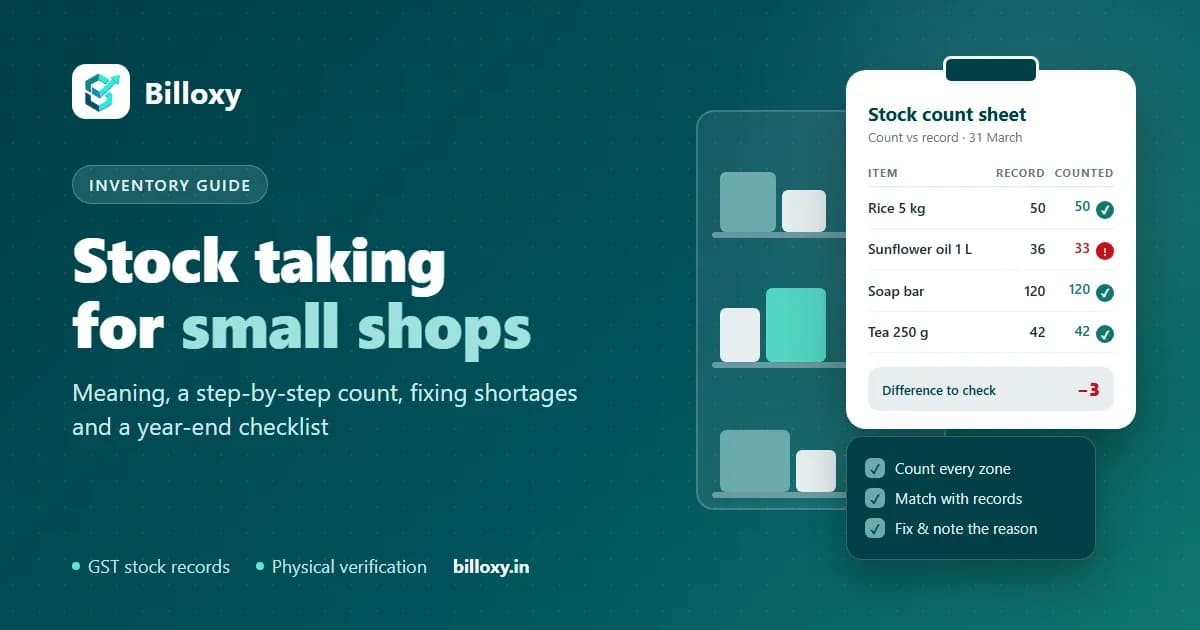
Stock taking (also called physical stock verification or a stock count) means counting every item actually on your shelves and in your godown, then matching that count with what your stock records say. The gaps it finds show losses, billing mistakes and missing entries, and the final count gives you the closing stock for your books.
Updated 24 October 2026. This guide is for owners of kirana and grocery stores, medical shops, garment and footwear shops, hardware stores, mobile shops and small wholesalers. It covers when to count, how to run a count in one day, what to do with the differences, and the GST record-keeping points that apply. It is not tax or audit advice. For your own books, check with your accountant.
What is the difference between stock taking, stock verification and a stock audit?
The words overlap, and shop owners use them loosely. This is how they are usually meant:
| Term | Who does it | What it means |
|---|---|---|
| Stock taking / stock count | The owner and staff | Counting the goods on hand at a point in time |
| Physical stock verification | The owner, staff or an accountant | Counting the goods and checking the count against the stock records |
| Stock audit | An outside auditor, often for a bank or lender | An independent check of stock quantity, value and condition against the books and stock statements |
For a small shop, stock taking and physical stock verification are the same job: count, compare, correct. A stock audit is a separate exercise run by someone outside the business.
Why should a small shop do stock taking?
A count is the only way to know that the number on your screen or in your register is the number on your shelf. It helps you:
- Find losses early. Theft, breakage, expiry and items handed out without a bill show up only as a shortfall at the count.
- Catch billing and entry mistakes. A wrong item picked at billing, a purchase never entered, or a return not recorded all leave the record out of step with the shelf.
- Get closing stock right. The value of stock on the last day of the year feeds your profit for the year. A guessed closing stock means a guessed profit. See what a profit and loss statement shows.
- Reorder on facts. You cannot set sensible reorder levels if the stock figure is wrong. Accurate counts help you avoid both stockouts and over-buying.
- Spot slow movers. Walking every shelf is the best moment to note items that have not moved. Our guide to dead stock explains what to do with them.
- Keep GST stock records accurate. GST rules ask most registered businesses to keep a stock account, including goods lost or written off (explained below).
When should you do a stock count?
There is no single right frequency. Most small shops combine these:
| Type of count | When | What it covers | Good for |
|---|---|---|---|
| Full count (periodic) | At least once a year, at the end of the financial year (31 March) | Every item in the shop and godown | Closing stock for the books |
| Cycle count | Every week or month | A few categories or shelves at a time, in rotation | Busy shops that cannot close for a day |
| Spot check | Any day, without notice | High-value or often-missing items | Mobiles, cosmetics, medicines, branded goods |
| Event count | After a festive season, a shop move, a staff change or a suspected theft | The affected stock | Finding out what happened |
A sensible pattern for a small shop: a full count at year end, a cycle count of one or two categories every week, and spot checks on high-value items.
How to do stock taking in your shop: step by step
Before the count
- Pick a date and time when billing is closed or quiet, such as early morning, after closing, or a weekly off day. Counting while you sell creates double entries.
- Finish all pending entries. Enter every purchase bill, sales return and supplier return up to the count date, so the record is complete.
- Print or export the item list with item name, code or barcode, unit and the quantity your records show. Many owners count "blind" first (without seeing the expected quantity) so the count is honest, then compare.
- Tidy and label the shelves. Group the same item in one place. Put damaged, expired and returned goods in a separate, marked area.
- Split the shop into zones, such as shelf 1 to 10, the counter, the godown and the display window. Give each zone to a pair of people: one counts, one writes.
- Decide what to do with goods in transit: goods paid for but not yet arrived, or sold but not yet delivered. Count them in one place only.
During the count
- Count in the item's selling unit: pieces, strips, kg, litres, boxes. Write loose quantities separately from sealed cartons.
- Count every zone once, in order, and mark each shelf as done.
- Note the condition: damaged, expired, near-expiry or unsaleable goods are counted and listed separately.
- Recount high-value items, or ask a second person to count them.
- Do not move stock between zones until the count is finished.
After the count
- Compare the count with the record for every item and list the differences (shortage or excess).
- Recount the big differences before you accept them. Many gaps disappear on a second count.
- Find the reason for each confirmed difference (see the next section).
- Correct the stock record so it matches the shelf, with a note of the reason and date.
- Value the closing stock and share the count sheets with your accountant for the year-end books.
- Keep the signed count sheets with your records.
What do you do when the count does not match the records?
A difference is a signal, not just a number to correct. Common causes and fixes:
| What you find | Likely cause | What to do |
|---|---|---|
| Shelf has less than the record | Theft, breakage, expiry, item given without a bill, wrong item billed | Recount, check recent bills for that item, then record a stock-out adjustment with the reason |
| Shelf has more than the record | Purchase not entered, sales return not recorded, wrong item billed | Find the missing purchase or return entry first; adjust only if none exists |
| Gap between two similar items | Wrong variant picked at billing (size, flavour, pack) | Correct both items and train staff to bill by barcode or code |
| Damaged or expired goods | Storage or slow sales | Move to a separate area; return to supplier if allowed, otherwise write off |
| Same item keeps going short | Repeated loss or a process gap | Spot-check it weekly and limit who handles it |
Record the reason for every adjustment. A list of reasons over a year shows where money is leaking.
What do GST rules say about stock records and stock losses?
Two official rules matter most when you take stock.
Stock account. Under Rule 56(2) of the CGST Rules, every registered person, other than a person paying tax under section 10 (the composition scheme), must keep stock accounts for goods received and supplied. They must show the opening balance, receipts, supplies, goods lost, stolen, destroyed, written off or given away as gifts or free samples, and the balance of stock. A regular stock count is how you keep that account true.
Input tax credit on lost or written-off goods. Section 17(5)(h) of the CGST Act blocks input tax credit on goods lost, stolen, destroyed, written off or disposed of as gifts or free samples. If your count shows such a shortfall on goods where you claimed input tax credit, that credit has to be reversed. Ask your accountant how to report it for your return period.
Year-end stock taking checklist
Use this list for the 31 March count (or any full count):
- Fix the count date and tell staff and suppliers
- Enter all purchase bills, returns and credit notes up to the count date
- Export or print the item list with codes and units
- Tidy shelves; separate damaged, expired and returned goods
- Split the shop and godown into zones and assign counting pairs
- Count, write and sign each zone sheet
- Recount high-value items and every large difference
- List shortages and excesses with a reason for each
- Correct the stock record and note the date and reason
- Mark items with no sales in the year as slow-moving
- Hand count sheets and the closing stock list to your accountant
- Ask about input tax credit reversal on goods lost or written off
Tips to make stock taking faster next time
- Bill every sale item-wise. If sales are billed as "misc" or a lump sum, the record can never match the shelf.
- Use barcodes or item codes on items that look alike, so the right variant is billed.
- Count by category in a weekly cycle, so the year-end count only confirms what you already know.
- Keep one place per item. Stock spread across three shelves and the godown is where counts go wrong.
- Record damage and expiry the day you find it, not at the year-end count.
- Set low-stock levels for fast movers so you notice gaps between counts.
How Billoxy helps with stock taking
Billoxy is AI-powered GST billing, invoicing, inventory and business-management software for Indian MSMEs. It does not count your shelves for you, but it keeps the record you count against and makes corrections traceable:
- One Items catalogue. Each product has its HSN/SAC, GST rate, units, barcode and prices in the Items master, with Excel import for a large list.
- Stock that follows billing. Sales and purchase invoices update stock, so the expected quantity is ready when you count. See inventory management.
- Typed stock corrections. On the Stocks screen, Stock In types include Opening Stock and Add Stock, and Stock Out types include Usage Slip, Scrap Slip and Reduce Stock, so a shortage or write-off is recorded with its type and description. Bulk Stock Adjustment from Items handles many items at once, and each item keeps its transaction history.
- Export. The stock transaction list can be filtered and exported to share with your accountant.
- Low-stock reminders. Reminder alerts you when stock runs low between counts.
- Reports and AI Chat. Reports give sales and purchase summaries for any period, and Billoxy's AI agents can answer questions about your business reports. You can try them in AI Chat.
Running a retail shop? See billing software for retail stores. To bill and track stock in one place, start the 10-day trial or compare plans on pricing.
Questions shop owners ask about stock taking
What is stock taking in simple words?
Stock taking is counting all the goods your shop holds on a given day and checking that count against your stock records. It tells you what you really have, what is missing and what your closing stock is worth.
Is physical stock verification the same as stock taking?
For a small shop, yes. Both mean counting the goods and matching the count with the records. "Verification" stresses the matching step. A stock audit is different: it is an independent check, often done by an outside auditor for a bank or lender.
How often should a small shop do stock taking?
At least once a year at the end of the financial year (31 March), for closing stock. Many shops also count one or two categories every week in rotation and spot-check high-value items, so the yearly count holds no surprises.
What is the difference between cycle counting and a full stock count?
A full count covers every item on one day, usually with billing stopped. Cycle counting covers a small part of the stock at a time on a rotating schedule, so every item is counted several times a year without closing the shop.
What should I do if my stock count is less than my records?
Recount first, then check recent bills, purchases and returns for that item. If the shortage is real, correct the stock record with the reason (damage, expiry, theft or billing error). If you claimed input tax credit on goods that were lost or written off, Section 17(5)(h) of the CGST Act requires that credit to be reversed.
Do GST rules require a stock register?
Rule 56(2) of the CGST Rules requires registered persons, other than those paying tax under the composition scheme (section 10), to keep stock accounts showing the opening balance, receipts, supplies, goods lost, stolen, destroyed, written off or given as gifts or free samples, and the balance of stock.
Official sources
- Rule 56, CGST Rules 2017 — Maintenance of accounts by registered persons — CBIC, read 24 October 2026
- Section 17, CGST Act 2017 — Apportionment of credit and blocked credits — CBIC