
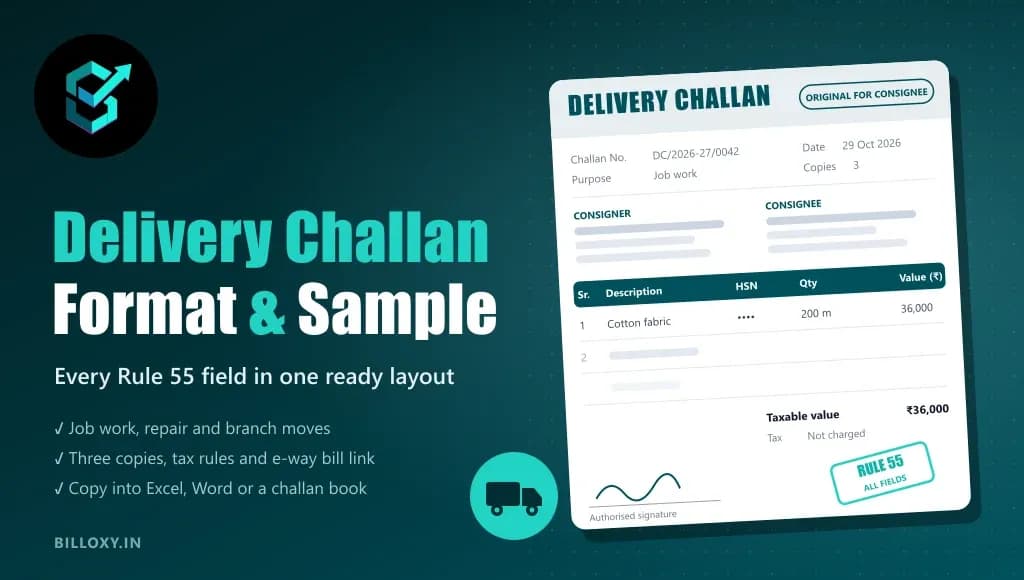
A delivery challan format is the layout of the document that travels with goods moved without a tax invoice, such as goods sent for job work. Rule 55 of the CGST Rules requires the challan number and date, consigner and consignee details, HSN, description, quantity, taxable value, tax when goods move for supply, place of supply and a signature.
Make challans without retyping: Billoxy lists the delivery challan among the documents you create and save, next to sales invoices, proforma invoices and credit notes. Start the 10-day free trial, or copy the layout below into Excel, Word or a printed challan book.
Updated 29 October 2026. This guide is for Indian traders, distributors, manufacturers and shop owners who send goods out without billing them at that moment. It gives a layout you can copy, the Rule 55 field rules behind it, the copies you need, and how the challan fits with the tax invoice and the e-way bill. It is not tax advice; for your own case, check with your chartered accountant.
What does a delivery challan format look like?
A delivery challan has five blocks, top to bottom. Copy this layout into a spreadsheet, a Word table or your printer's challan-book design.
Block 1: header
| Field | What to write |
|---|---|
| Title | "Delivery Challan" |
| Consigner name and address | Your business name and the address the goods leave from |
| Consigner GSTIN | Your 15-character GSTIN, if you are registered |
| Challan number | A serial number of up to 16 characters, in one or more series (for example DC/2026-27/0042) |
| Challan date | The date the goods are removed for transport |
| Purpose of movement | Job work, repair, own branch transfer, supply of liquid gas, or another reason |
| Copy marking | "Original for consignee" (and duplicate and triplicate copies, see below) |
Block 2: consignee and route
| Field | What to write |
|---|---|
| Consignee name and address | The person or place receiving the goods |
| Consignee GSTIN or UIN | If the consignee is registered |
| Place of supply | State name and state code, for an inter-state movement |
| Transport details | Vehicle number, transporter, and e-way bill number if one is generated (useful, not listed in Rule 55) |
Block 3: item table
| Sr. | Description | HSN | Qty | Unit | Rate (₹) | Taxable value (₹) | GST rate | CGST (₹) | SGST (₹) | IGST (₹) |
|---|---|---|---|---|---|---|---|---|---|---|
| 1 | ||||||||||
| 2 |
Fill the tax columns only when the goods are moving for supply to the consignee. For job work, repair or a move between your own premises, show the taxable value and leave the tax columns blank. If the exact quantity is not known when the goods leave (for example liquid gas), write a provisional quantity.
Block 4: totals
| Line | Amount (₹) |
|---|---|
| Total quantity | |
| Total taxable value | |
| Total tax (if moving for supply) | |
| Value in words |
Block 5: footer
- Reference to the tax invoice, if the challan is for a later lot of an invoiced supply
- "Goods returnable: Yes / No" and the expected return date, for job work or repair (useful for your own tracking)
- Receiver's signature and date on your copy
- Signature of the consigner or an authorised person
Which fields must a delivery challan have under Rule 55?
Rule 55 of the CGST Rules lists the details. Here they are in plain words.
| Rule 55 field | When it applies |
|---|---|
| Date and number of the delivery challan, serially numbered, up to 16 characters, in one or more series | Always |
| Name, address and GSTIN of the consigner | GSTIN if the consigner is registered |
| Name, address and GSTIN or UIN of the consignee | GSTIN or UIN if the consignee is registered |
| HSN code and description of goods | Always |
| Quantity | Always; provisional when the exact quantity is not known |
| Taxable value | Always |
| Tax rate and amount (CGST, SGST, IGST, UTGST or cess) | Only when the goods move for supply to the consignee |
| Place of supply | For an inter-state movement |
| Signature | Always |
When do you issue a delivery challan instead of a tax invoice?
Rule 55 allows a delivery challan in place of an invoice, at the time the goods are removed for transport, in four cases:
- Supply of liquid gas where the quantity is not known when it leaves your place of business.
- Goods sent for job work, for example fabric sent to a stitching unit or parts sent for machining.
- Movement for reasons other than supply, for example goods sent for repair, to an exhibition, or between your own premises under the same GSTIN.
- Other supplies the CBIC notifies.
Two related situations are also in the rule:
- Goods sent for supply before you can issue the invoice. The supplier issues the tax invoice after delivery (Rule 55(4)).
- Goods sent in lots or batches, or in semi knocked down or completely knocked down condition. Issue the complete invoice before the first lot leaves, then a delivery challan for each later lot that refers to that invoice. Each lot travels with its challan and a certified copy of the invoice, and the original invoice goes with the last lot (Rule 55(5)).
A normal sale to a customer needs a tax invoice, not a challan.
How many copies of a delivery challan do I need?
For goods, Rule 55(2) asks for three copies:
| Copy | Marking |
|---|---|
| Original | "ORIGINAL FOR CONSIGNEE" |
| Duplicate | "DUPLICATE FOR TRANSPORTER" |
| Triplicate | "TRIPLICATE FOR CONSIGNER" |
Keep the triplicate, ideally signed by the receiver, so you can show where the goods went and match them when they come back.
What is a sample delivery challan?
Here is a worked example with sample figures.
A garment trader in Maharashtra (state code 27) sends 200 metres of cotton fabric to a stitching unit in the same state for job work. Nothing is sold, so no tax is charged on the challan.
| Field | Entry |
|---|---|
| Challan number and date | DC/2026-27/0042, 29 October 2026 |
| Purpose | Job work (stitching) |
| Consigner | Your business name, address and GSTIN |
| Consignee | The stitching unit's name, address and GSTIN (if registered) |
| Item | Cotton fabric, HSN as per your item master, 200 metres |
| Taxable value | ₹36,000 (200 m × ₹180) |
| Tax | Not charged (movement for job work, not a supply to the job worker) |
| Copies | Original to the job worker, duplicate with the transporter, triplicate kept |
When the stitched garments come back, record the return against this challan number so your stock and the job worker's balance stay correct.
Delivery challan vs tax invoice vs e-way bill: what is the difference?
| Point | Delivery challan | Tax invoice | E-way bill |
|---|---|---|---|
| What it is | A movement document when goods leave without a sale (or before the invoice) | The bill for a taxable supply | An electronic movement record generated on the e-way bill portal |
| Rule | Rule 55 | Rule 46 | Rule 138 |
| Tax charged | Only shown when the goods move for supply | Yes | Records the tax from the invoice or challan |
| Buyer's input tax credit | No | Yes, from a correct invoice | No |
| Who keeps it | Consignee, transporter, consigner | Buyer, transporter (goods), supplier | Generated by the person causing the movement |
Rule 55(3) says goods moving on a delivery challan must be declared as Rule 138 requires. In other words, a challan can need an e-way bill too, just like an invoice. Our guides to what an e-way bill is and how to generate an e-way bill online cover the value limit and the steps.
Is a delivery challan format different for job work and for returnable goods?
The Rule 55 fields are the same. What changes is what you add for your own tracking:
| Type | Add to the format |
|---|---|
| Job work challan | Purpose "Job work", the process (stitching, polishing, machining), and the expected return date |
| Returnable challan (repair, exhibition, demo) | "Goods returnable: Yes" and the expected return date |
| Non-returnable challan (own branch, same GSTIN) | Receiving location; no tax columns |
| Challan for a lot of an invoiced supply | The invoice number and date it belongs to |
Rule 55 does not set these extra lines; they help you match goods out with goods back. For how long job-work goods may stay out, and what happens if they are not returned, follow the CGST Act section on job work and your CA's advice.
Excel, Word, a challan book or billing software: which should I use?
| Option | Good for | Watch out for |
|---|---|---|
| Printed challan book | A few movements a week | Three copies by hand; returns tracked on paper |
| Excel or Word template | Occasional challans | Challan numbers can repeat or skip; HSN and addresses typed each time; no link to stock |
| Billing software with challans | Regular job work, branch moves or lot deliveries | Monthly cost after the trial; a short setup of items and parties |
A template works when you send goods out now and then. If you send goods to job workers every week, the hard part is not the format but the follow-up: which challans are still open, which goods came back short, and which lot belongs to which invoice.
Common mistakes in a delivery challan
- Using a challan for a normal sale. A sale needs a tax invoice when the goods are removed.
- Restarting or repeating challan numbers. Keep a serial series of up to 16 characters.
- No HSN code or taxable value because "it is only a challan". Rule 55 asks for both.
- Forgetting the place of supply on an inter-state movement.
- Only one copy. Goods need three, marked for consignee, transporter and consigner.
- Not checking the e-way bill rule for goods moving on a challan.
- No signed copy back from the receiver, which makes job-work returns hard to prove.
How Billoxy helps
Billoxy is GST billing, invoicing and inventory software for Indian MSMEs, on web and mobile.
- Billoxy's onboarding guide lists delivery challans among the documents you create and save, alongside sales, purchase, orders, proforma invoices, expenses, credit and debit notes, and stock in and stock out.
- Your saved items and parties carry the HSN codes and addresses, so you don't type them on every document. See the inventory feature.
- When the goods are sold, the sales invoice applies CGST, SGST or IGST line by line. Billoxy's documented e-way bill flow starts from a sales invoice after GST portal (Iris) onboarding.
Invoice creation takes under 5 seconds once your items and customers are saved. Start the 10-day free trial to keep challans, invoices and stock in one place.
Frequently asked questions
Is there one official delivery challan format?
No. Rule 55 lists the details a delivery challan must contain, not a fixed design. Any layout is fine if it shows every required field.
Is GST charged on a delivery challan?
Tax is shown on the challan only when the goods are transported for supply to the consignee. For job work, repair or a move between your own premises under the same GSTIN, the challan shows the taxable value without tax.
Can I make a delivery challan in Excel or Word?
Yes, if every Rule 55 field is there, the challan numbers stay serial, and you print three copies for goods.
Does a delivery challan need an e-way bill?
It can. Rule 55(3) says goods moving on a delivery challan must be declared as Rule 138 (the e-way bill rule) requires. Check the value limit and conditions in the e-way bill guide.
What is the difference between a delivery challan and a delivery note?
"Delivery note" is a common business name for a paper that goes with goods. Under GST, the document Rule 55 describes is the delivery challan, so use that title and its fields when goods move without an invoice.
Related Billoxy guides
- GST invoice format
- What is a proforma invoice?
- What is an e-way bill in GST?
- GST state code list
- Billing software for clothing stores
Official sources
- Rule 55, CGST Rules — Transportation of goods without issue of invoice — CBIC (read 29 October 2026)
- Rule 46, CGST Rules — Tax invoice — CBIC
- Rule 138, CGST Rules — E-way bill — CBIC