
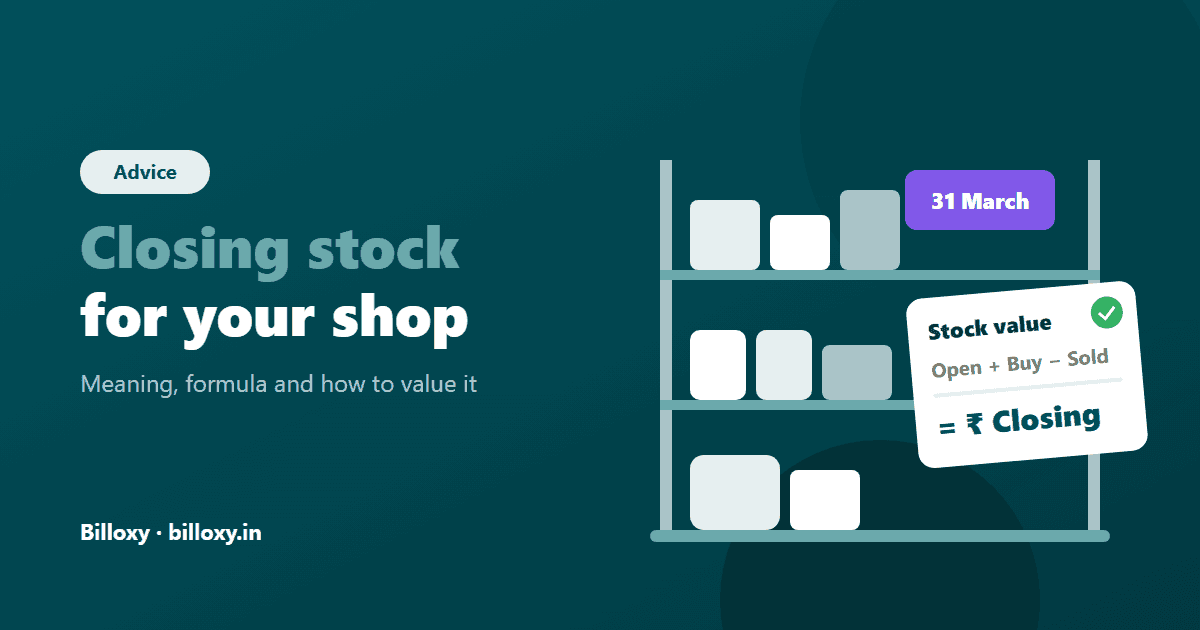
Closing stock is the value of the unsold goods your shop holds on the last day of a period, usually 31 March. The formula is Closing stock = Opening stock + Purchases − Cost of goods sold. For your year-end books, count what is on the shelf and value each item at the lower of its cost and what it can be sold for.
Updated 13 November 2026. This guide is for owners of kirana and grocery stores, medical shops, clothing shops, hardware stores and other small retailers and wholesalers in India. It explains what closing stock means, the formula, two ways to calculate it with rupee examples, how GST affects the value, and the mistakes that change your profit. It is not accounting or tax advice. For your own books, check with your accountant.
If your stock figure lives in a notebook today, you can start the 10-day trial and let your sales and purchase bills update stock as you work, or read how inventory management works in Billoxy.
What does closing stock mean?
Closing stock (also called closing inventory or ending inventory) is the goods your business bought or made for sale and has not yet sold at the end of an accounting period, shown at their value in rupees. For a shop, it is everything still on the shelves, in the godown and in the display window on the closing date.
Three things to keep in mind:
- It is a value, not just a count. "40 packs of toor dal" is a quantity. "40 packs at ₹140 each = ₹5,600" is closing stock.
- It has a date. Closing stock is always "as on" a date: the end of a month, a quarter or the financial year (31 March).
- This year's closing stock is next year's opening stock. The ₹1,60,000 you close with on 31 March is the ₹1,60,000 you open with on 1 April.
Why does closing stock matter for a shop owner?
Closing stock decides your profit. Your cost of goods sold for the year is worked out as opening stock plus purchases minus closing stock. So:
- If you overstate closing stock by ₹20,000, your cost of goods sold falls by ₹20,000 and your profit looks ₹20,000 higher than it really is.
- If you understate it by ₹20,000, your profit looks ₹20,000 lower.
That is why a guessed closing stock means a guessed profit. It also shows up in your profit and loss statement and balance sheet, it is what a bank looks at when stock backs a loan, and it tells you how much of your money is sitting on shelves instead of in the bank.
What is the closing stock formula?
The standard formula is:
Closing stock = Opening stock + Purchases − Cost of goods sold (COGS)
| Term | What it means for a shop | Where you get it |
|---|---|---|
| Opening stock | Value of stock on the first day of the period | Last period's closing stock |
| Purchases | Cost of goods bought for resale during the period, after trade discounts and returns to suppliers | Purchase bills, debit notes |
| Cost of goods sold | What the goods you sold cost you (not their selling price) | Item-wise purchase cost of the goods billed |
Turn it around and you get the formula your accountant uses for the trading account:
Cost of goods sold = Opening stock + Purchases − Closing stock
The catch for most small shops: you rarely know the exact cost of goods sold for every bill. That is why there are two practical ways to calculate closing stock.
How do you calculate closing stock? Two methods compared
| Point | Method 1: Count and value | Method 2: Formula estimate |
|---|---|---|
| How it works | Count every item on the closing date and multiply by its cost | Opening stock + purchases − estimated cost of goods sold |
| What you need | A physical count and item-wise purchase costs | Opening stock, total purchases, total sales and your usual margin |
| Accuracy | High, because it is what is really on the shelf | An estimate; theft, damage and billing mistakes stay hidden |
| Best for | Year-end books (31 March), bank stock statements | Month-end checks, a quick profit estimate, insurance claims |
| Effort | Half a day to a full day for a small shop | A few minutes |
Verdict: use the count for your year-end books, and the formula for quick checks in between. When the two are far apart, something is leaking: missed purchase entries, unbilled sales, theft or damage.
Method 1: Count your stock and value each item
This is the method your year-end books should rest on. Our guide to stock taking for small shops covers how to run the count itself. Once the count is done:
- List every item with its counted quantity, in the unit you buy and sell it in.
- Find its cost: the purchase price on the supplier bill, minus trade discounts, plus freight you paid to bring it in.
- Check whether it can still be sold at or above cost. Damaged, expired, near-expiry or out-of-fashion goods may sell only at a lower price.
- Value each item at the lower of the two: its cost, or what it can realistically be sold for (minus the cost of selling it).
- Add up all the items. The total is your closing stock.
Example: a kirana store on 31 March
All figures below are an example, not real prices.
| Item | Count | Cost per unit (₹) | Can sell for (₹) | Value used (₹) | Closing value (₹) |
|---|---|---|---|---|---|
| Toor dal 1 kg | 40 packs | 140 | 165 | 140 (cost) | 5,600 |
| Sunflower oil 1 L | 30 bottles | 150 | 175 | 150 (cost) | 4,500 |
| Basmati rice 5 kg | 12 bags | 520 | 600 | 520 (cost) | 6,240 |
| Biscuits, near expiry | 60 packs | 20 | 12 | 12 (lower) | 720 |
| Dented tins of ghee 500 ml | 4 tins | 310 | 250 | 250 (lower) | 1,000 |
| Total | 18,060 |
The biscuits and dented tins are valued below cost because they can no longer be sold at cost. Valuing them at the purchase price would overstate closing stock by ₹480 (biscuits) and ₹240 (ghee) and show a profit the shop will never earn.
Method 2: Use the formula when you can't count
When you need a figure between counts, estimate cost of goods sold from your sales and your usual gross margin, then apply the formula.
Example: a clothing shop's month-end estimate
All figures below are an example.
- Opening stock on 1 October: ₹2,00,000
- Purchases in October (cost, after discounts): ₹6,00,000
- Sales in October (selling price, without GST): ₹8,00,000
- Usual gross margin on sales: 20%
Step 1: Estimated cost of goods sold = Sales × (100% − margin) = ₹8,00,000 × 80% = ₹6,40,000
Step 2: Closing stock = ₹2,00,000 + ₹6,00,000 − ₹6,40,000 = ₹1,60,000
This is an estimate. It assumes every sale earned your usual margin and that nothing was lost, damaged or given away. Festive discounts, clearance sales and unrecorded losses all make it wrong. If you work out margins on cost rather than on sales, our guide to markup vs margin shows how to convert one into the other.
How should closing stock be valued: cost or selling price?
At cost, unless the goods are worth less than cost. The Institute of Chartered Accountants of India's Accounting Standard (AS) 2, Valuation of Inventories, says inventories should be valued at the lower of cost and net realisable value. Net realisable value is the estimated selling price in the normal course of business, minus the estimated costs needed to complete and make the sale.
Never value closing stock at your selling price (MRP or shelf price). That would count profit on goods you haven't sold yet.
| Valuation point | What AS 2 says | What it means in a shop |
|---|---|---|
| Basic rule | Lower of cost and net realisable value (para 5) | Purchase cost for normal stock; a lower value for damaged, expired or slow stock |
| What cost includes | Purchase price, duties and taxes other than those later recoverable from the tax authorities, freight inwards and other directly attributable costs, less trade discounts and rebates (para 7) | Supplier price + freight you paid − trade discount; GST you claim back is not part of cost |
| Cost formula for interchangeable items | First-in, first-out (FIFO) or weighted average cost (para 16) | Pick one method and use it every year |
FIFO or weighted average: which cost should you use?
When the same item was bought at different prices during the year, you need a rule for which cost sits in closing stock. AS 2 names two formulas for ordinary, interchangeable stock:
| Point | FIFO (first-in, first-out) | Weighted average |
|---|---|---|
| Assumption | The oldest stock is sold first, so closing stock is at the latest purchase prices | Every unit carries the average cost of opening stock and purchases |
| When prices are rising | Higher closing stock, higher profit | Closing stock and profit between the oldest and newest prices |
| Easy for | Medicines, packaged food and anything sold in expiry order | Grains, oil, hardware, fabric bought in many lots |
| Example: 100 units opening at ₹50, 100 bought at ₹60, 120 sold | 80 left at ₹60 = ₹4,800 | Average ₹55 × 80 = ₹4,400 |
Choose the method that matches how goods really move in your shop, agree it with your accountant, and keep it year after year. Switching methods every year makes profits impossible to compare.
How does GST affect the value of closing stock?
It depends on whether you can claim back the GST you paid on purchases.
- Regular GST-registered shop that claims input tax credit: the GST on your purchase bills is recoverable, so under AS 2 it is not part of the cost of stock. Value closing stock at the price before GST. A pack bought for ₹140 + ₹7 GST is stock worth ₹140. See how to claim input tax credit.
- Composition scheme shop: Section 10(4) of the CGST Act says a person paying tax under the composition scheme cannot take credit of input tax. The GST you pay is a cost you keep, so it is included in the value of your stock.
- Shop not registered for GST: the same logic applies. GST you can't recover is part of the cost.
Two GST record points also touch closing stock:
- Stock account. Rule 56(2) of the CGST Rules asks registered persons, other than composition taxpayers, to keep stock accounts showing the opening balance, receipts, supplies, goods lost, stolen, destroyed, written off or given as gifts or free samples, and the balance of stock.
- Goods written off. Section 17(5)(h) of the CGST Act blocks input tax credit on goods lost, stolen, destroyed or written off. If your count removes such goods from closing stock and you had claimed credit on them, that credit has to be reversed. Our guide to dead stock covers what to do with goods that won't sell.
Closing stock by trade: what to watch
| Trade | What makes closing stock tricky | What to do |
|---|---|---|
| Kirana and grocery | Loose goods sold by weight, many small items | Weigh loose stock on the closing date; value packaged and loose stock separately |
| Medical store | Expiry dates, batch-wise purchase prices | Value near-expiry and expired medicines below cost; use FIFO by batch |
| Clothing and footwear | Sizes and colours, end-of-season styles | Count by size and colour; mark down last season's styles to what they will really sell for |
| Hardware | Many lots of the same item at different prices | Weighted average cost is often simpler |
| Mobile and electronics | Fast price drops on older models | Check today's selling price for older models; it may be below cost |
Running one of these trades? See Billoxy for grocery stores, medical stores, clothing stores and hardware shops.
Before your 31 March close: a closing stock checklist
The financial year ends on 31 March, and your closing stock on that date goes into the year's books. Use this list in the last week of March:
- Enter every purchase bill, sales return and supplier return up to 31 March
- Bill every sale item-wise, so the system's quantity matches the shelf
- Separate damaged, expired and returned goods before you count
- Count the shop, godown and display stock (see stock taking)
- Value each item at cost, without recoverable GST, after trade discounts
- Mark down damaged, expired and slow items to what they will really sell for
- Use the same cost method (FIFO or weighted average) as last year
- Agree with your accountant how to treat goods in transit and goods sold but not yet delivered, and count each in one place only
- Hand the count sheets and valued stock list to your accountant
- Carry the final figure forward as opening stock on 1 April
Common closing stock mistakes
- Valuing stock at selling price or MRP. This books profit on goods not yet sold.
- Including GST you will claim back. For a regular GST shop, stock is valued before GST.
- Keeping dead and damaged stock at full cost. It inflates profit and hides a loss you will take later.
- Missing purchase entries. Goods on the shelf with no purchase bill entered make closing stock look higher than purchases allow.
- Counting the same goods twice, once in the godown and once in transit.
- Changing the valuation method every year, so profits can't be compared.
- Rolling last year's figure forward without a count. Losses build up silently.
How Billoxy helps you keep closing stock in check
Billoxy is AI-powered GST billing, invoicing, inventory and business-management software for Indian MSMEs. It does not value your stock for your accounts, but it keeps the stock record you count against and the purchase data your accountant needs:
- Stock that follows billing. Sales and purchase invoices update stock, so you know the expected quantity of each item before you count. See inventory management.
- Opening stock per item. The Items master records an opening stock balance, HSN/SAC, GST rate, units, barcode and prices for each product, with Excel import for a long list.
- Typed stock corrections. On the Stocks screen, Stock In types include Opening Stock and Add Stock, and Stock Out types include Usage Slip, Scrap Slip and Reduce Stock, so damage, scrap and shortages are recorded with a reason. Bulk Stock Adjustment handles many items at once.
- Reports for the formula. Reports include Sales Summary, Purchase Summary and Sales vs Purchase by Item for any period, which give you the purchase and sales figures the formula needs.
- Low-stock reminders. Reminder alerts you when an item runs low, so gaps show up before the year-end count.
- Ask about your reports. Billoxy's AI agents can answer questions about your business reports. You can try them in AI Chat.
To bill and track stock in one place before your next year-end, start the 10-day trial or compare plans on pricing.
Questions shop owners ask about closing stock
What is closing stock in simple words?
Closing stock is the value of the goods your shop has not sold by the end of a period, such as 31 March. You find it by counting what is left and valuing each item at its cost, or at a lower value if it can only be sold for less than cost.
What is the formula for closing stock?
Closing stock = Opening stock + Purchases − Cost of goods sold. For example, ₹2,00,000 opening stock + ₹6,00,000 purchases − ₹6,40,000 cost of goods sold = ₹1,60,000 closing stock.
Is closing stock valued at cost price or selling price?
At cost price, or at net realisable value if that is lower. ICAI's AS 2 sets this "lower of cost and net realisable value" rule. Valuing stock at selling price counts profit on goods that are not sold yet.
Should GST be included in closing stock value?
For a regular GST-registered shop that claims input tax credit, no: the GST is recoverable, so AS 2 leaves it out of cost. For a composition scheme shop, which cannot claim input tax credit under Section 10(4) of the CGST Act, the GST paid is part of the cost.
What is the difference between opening stock and closing stock?
Opening stock is the value of goods on hand on the first day of a period. Closing stock is the value on the last day. The closing stock on 31 March becomes the opening stock on 1 April.
How does closing stock affect profit?
Cost of goods sold equals opening stock plus purchases minus closing stock. A higher closing stock lowers the cost of goods sold and raises profit; a lower closing stock does the opposite. An error in closing stock is an error of the same amount in gross profit.
Official sources
- Accounting Standard (AS) 2 (revised 1999), Valuation of Inventories — ICAI, paragraphs 5, 7 and 16, read 13 November 2026
- Section 10, CGST Act 2017 — Composition levy — CBIC, sub-section (4), read 13 November 2026
- Rule 56, CGST Rules 2017 — Maintenance of accounts by registered persons — CBIC, read 24 October 2026
- Section 17, CGST Act 2017 — Apportionment of credit and blocked credits — CBIC