
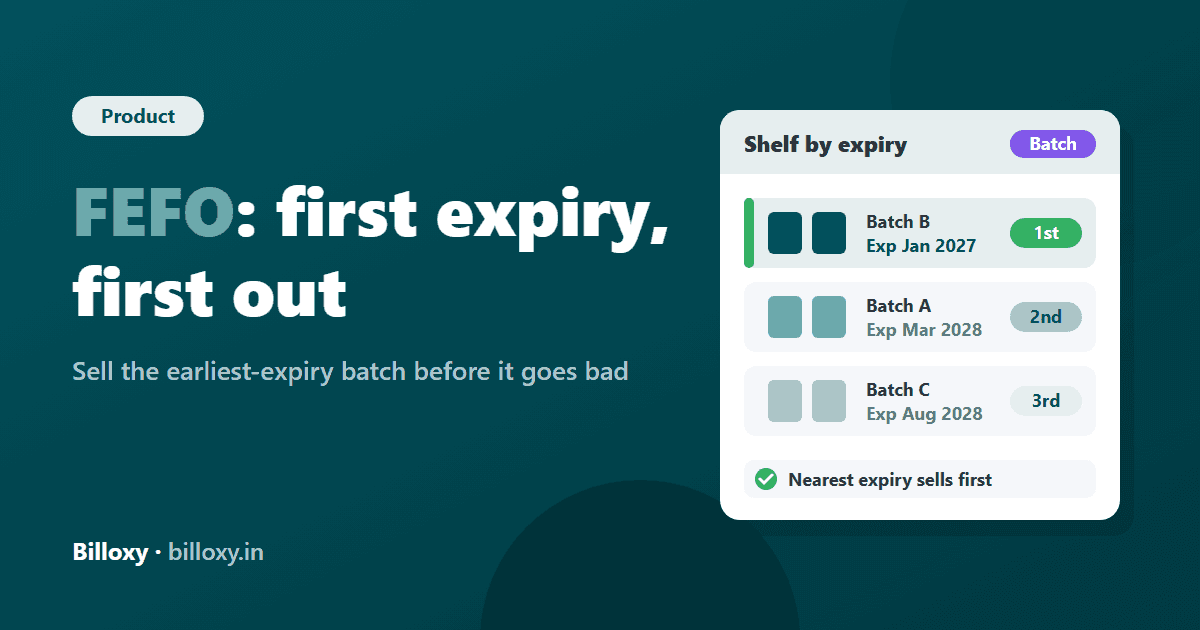
FEFO means First Expiry, First Out (also written First Expired, First Out). When a product with an expiry date sits on your shelf in more than one batch, you sell the batch that expires soonest first, even if it arrived later. FIFO sells the oldest stock first. FEFO sells the stock that will go bad first.
Updated 20 November 2026. This guide is for owners and counter staff at Indian medical stores, kirana and grocery shops, bakeries, dairies and cosmetics counters, anywhere a shelf holds medicines, food or other goods with a printed expiry date. It explains FEFO in plain words, shows a worked example, and gives a daily routine that works with or without software.
If you track batches in a notebook today, you can start the 10-day trial and let batch tracking in Billoxy pick the earliest-expiry batch on every sale.
What does FEFO mean?
FEFO is a rule for which unit leaves the shelf next. Every batch (lot) of a product carries a manufacturing date and an expiry date. Under FEFO, the batch with the nearest expiry date is picked first, whatever the date of purchase.
It matters for anything with a shelf life:
- Medicines: tablets, syrups, injections, ointments and surgical items.
- Packaged food: biscuits, namkeen, packaged atta, oil, spices, baby food.
- Dairy and bakery: milk, paneer, curd, bread, cakes.
- Cosmetics and personal care: creams, shampoos, sunscreen.
- Others: batteries, paints and adhesives, seeds, pesticides.
Goods without an expiry date (mobiles, clothes, hardware) don't need FEFO. For those, FIFO or simple counting is enough.
FEFO vs FIFO vs LIFO: what is the difference?
All three are rules for which stock goes out first. They give different answers when a newer batch expires before an older one.
| Method | Which stock goes out first | Best for | Risk if used for expiry goods |
|---|---|---|---|
| FEFO (First Expiry, First Out) | The batch with the nearest expiry date | Medicines, food, dairy, cosmetics | None for expiry; needs expiry dates recorded per batch |
| FIFO (First In, First Out) | The batch received first | Goods without expiry, or where every new batch expires later than the old one | An older purchase with a longer shelf life is sold first while a newer, shorter-life batch expires |
| LIFO (Last In, First Out) | The batch received last | Non-perishable bulk goods such as sand or bricks, where the top of the pile is the easiest to reach | Old stock at the back keeps ageing and expires |
Verdict: for any product with an expiry date, use FEFO on the shelf. FIFO works when every new batch from your supplier expires later than the old one, which is common but not guaranteed. A short-dated lot, a scheme offer or a different distributor can break that. LIFO is a warehouse habit, not a method for expiry goods.
FEFO decides which physical batch you hand over. It is a shelf and billing rule. It does not change how you value closing stock in your accounts. For stock valuation, see closing stock for small shops.
FEFO example: two batches of the same syrup
A medical store buys the same cough syrup twice:
| Batch | Purchased on | Qty | Expiry |
|---|---|---|---|
| B-1021 | 2 September | 20 | March 2028 |
| B-1187 | 10 October | 20 | January 2027 |
On 20 November a customer asks for 2 bottles.
- FIFO gives batch B-1021, because it arrived first.
- FEFO gives batch B-1187, because it expires first (January 2027).
If the store follows FIFO, B-1187 keeps waiting behind the older stock and may still be on the shelf in January. Those bottles then go back to the distributor or into the loss register. FEFO sells them while they are still good. Batch numbers and dates are illustrative.
The same thing happens in a kirana shop with packaged atta, biscuits or oil when a new consignment has a shorter shelf life than the stock already on the rack.
How to follow FEFO in a small shop
You can run FEFO with a register and a shelf rule. These steps work without any software.
- Record the batch and expiry on every purchase. Write the batch number, quantity and expiry date from the supplier bill into your stock register or purchase file, item by item.
- Arrange the shelf by expiry, not by arrival. Put the nearest-expiry batch in front (or on top) and newer, longer-life stock behind it. When new stock arrives, check its expiry before placing it.
- Mark the date where staff can see it. A marker on the box ("Exp 01/27") or a coloured sticker for "expires within 3 months" saves time at the counter.
- Check near-expiry stock on a fixed day. Once a week, list items expiring in the next 30, 60 and 90 days. Many distributors take back near-expiry stock only within their own return window, so check each supplier's terms.
- Act on what the list shows. Move near-expiry stock to the front, offer it first, return it to the supplier while returns are still allowed, or stop reordering that item for now.
- Write the batch on the bill when it matters. For medicines, writing the batch number and expiry on the bill helps if a customer comes back with a complaint or a return.
The weak point is step 1. If the batch and expiry are not written down when stock comes in, nobody can follow FEFO later.
How to use FEFO in Billoxy, step by step
Billoxy's inventory tracking lets you track items by batch, with manufacturing and expiry dates. Here is the job from purchase to sale:
- Turn on batch tracking for the items that need it. You choose item by item. Medicines and food can use Batch tracking, while items without expiry stay as they are.
- Enter the batch when stock comes in. On the purchase invoice or Stock In, enter the batch number with its manufacturing and expiry dates.
- Sell without choosing the batch. On the sales invoice, leave the batch blank and Billoxy picks the batch that expires first (FEFO). You can still choose a specific batch when you need to.
- Check the expiring-batches list. It shows what to sell or return first, so you can act before the date passes.
- Keep selling old stock. Stock you had before turning on tracking stays sellable without batch numbers, so you don't have to re-enter it.
Batch tracking sits inside Billoxy's inventory management. Item, stock and batch reports are in the Report Center, where you can print them or download a CSV.
FEFO by trade
| Trade | What to track by batch | FEFO tip |
|---|---|---|
| Medical store | Every medicine and surgical item with an expiry date | Check the near-expiry list every week and return eligible stock to the distributor before the return window closes |
| Kirana and grocery | Packaged food, oil, atta, baby food, beverages | Check the date on each new carton before stacking. A new consignment is not always longer-dated |
| Bakery and dairy | Bread, cakes, paneer, curd | Expiry is days, not months, so stack each morning: today's earliest-expiry stock goes in front |
| Cosmetics counter | Creams, sunscreen, hair care | Slow sellers expire on the shelf. Use the list to put them on offer early |
| General retail | Batteries, adhesives, packaged goods | Track only the items that expire; leave the rest untracked |
If you are setting up a new pharmacy, the medical store guide covers licences and setup. For stock that has stopped moving, see dead stock for small shops and stock management for small shops.
Common FEFO mistakes
- Placing new stock in front. Staff put the new carton on the shelf where it is easiest to reach, and the older, shorter-life stock goes behind.
- Assuming new stock is always longer-dated. It usually is, but not always. Check the date on each consignment.
- Recording quantity but not batch. Your register shows 40 bottles, but you can't tell which 20 expire in January.
- Checking expiry only at year end. By then, the return window for many batches has closed.
- Mixing batches in one box. Once two batches are in one box, nobody can follow FEFO for that box.
FAQ
What is the full form of FEFO?
FEFO stands for First Expiry, First Out, also written First Expired, First Out. It means the stock with the nearest expiry date is sold or used first.
Is FEFO better than FIFO?
For goods with an expiry date, yes: FEFO sells the batch that will expire first, so less stock goes to waste. For goods without an expiry date, FIFO is simpler and works well.
Does FEFO change how I value closing stock?
No. FEFO is about which physical batch leaves the shelf. Closing stock valuation follows your accounting method and is a separate decision.
Can I follow FEFO without software?
Yes. Record batch and expiry on every purchase, stack the shelf by expiry, and check near-expiry stock every week. Software helps when you have many items, batches or staff, because it picks the batch and lists near-expiry stock for you.
Want the batch with the nearest expiry picked on every bill? Start the 10-day trial and turn on batch tracking for the items that expire.