
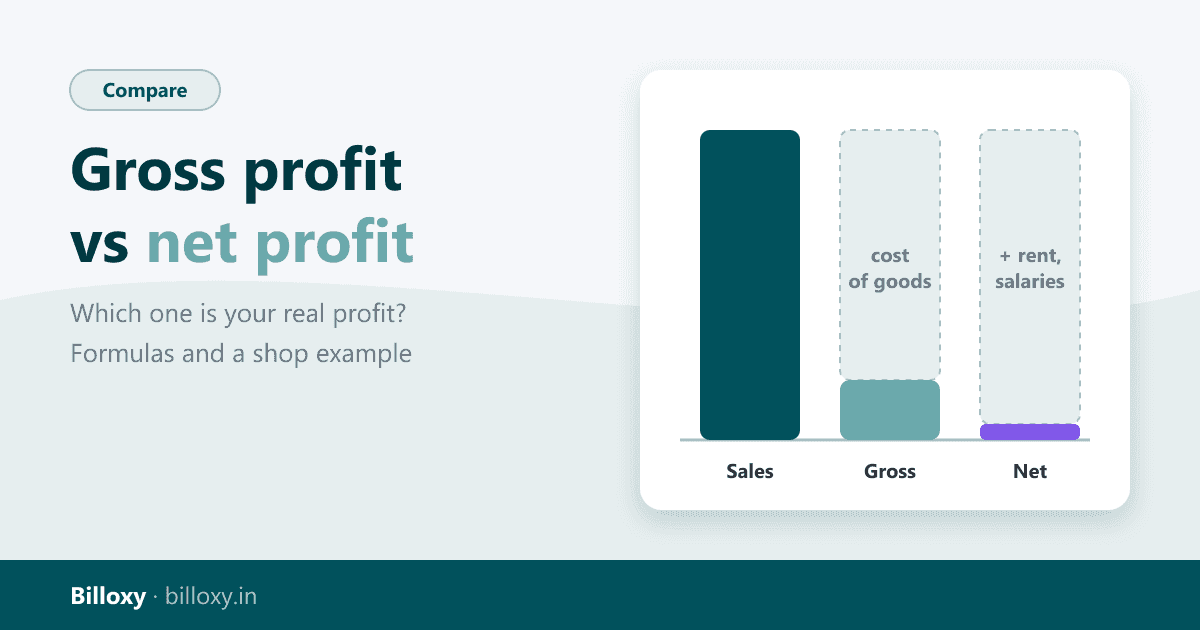
Gross profit is your sales minus what the goods you sold cost you. Net profit is what is left after you also pay rent, salaries, electricity, transport, interest and every other running cost. Gross profit tells you whether your prices work. Net profit tells you whether the whole shop makes money.
Updated 26 November 2026. This guide is for owners of kirana and grocery stores, medical stores, clothing, mobile and electronics shops, bakeries, hardware shops and other small businesses in India. It covers both formulas, a worked one-month example, the reasons a good gross profit can still end in a thin net profit, and how often to check each number.
Want both numbers without adding up bills by hand? Start the 10-day trial and open bill-wise profit and profit and loss in the Billoxy Report Center.
What is gross profit?
Gross profit is the money you make on the goods themselves, before any running costs. In Hindi it is called सकल लाभ (sakal labh).
Gross profit = Net sales − Cost of goods sold
- Net sales are your sales after returns and discounts, without GST. The GST on your sales bills is collected for the government, not earned by you.
- Cost of goods sold is what you paid for the goods you actually sold, also without the GST you can claim back. For a shop it is usually worked out as Opening stock + Purchases − Closing stock. Our guide to the closing stock formula shows how to value the stock left on the shelf.
Gross profit margin = Gross profit ÷ Net sales × 100
What is net profit?
Net profit is what the business actually earns after every cost. In Hindi it is called शुद्ध लाभ (shuddh labh).
Net profit = Gross profit − Operating expenses − Interest + Other income
Operating expenses are the costs of running the shop that do not belong to any one item: rent, staff salaries, electricity, internet and phone, transport and delivery, packaging, bank and card charges, repairs, and wear and tear on fridges, counters and computers. Income tax comes out last. This guide works with net profit before income tax, which is the number most owners check every month.
Net profit margin = Net profit ÷ Net sales × 100
Gross profit vs net profit: what is the difference?
| Gross profit | Net profit | |
|---|---|---|
| Formula | Net sales − Cost of goods sold | Gross profit − Operating expenses − Interest + Other income |
| What it takes out | Only the cost of the goods sold | Goods, plus rent, salaries, power, transport, interest and other running costs |
| What it tells you | Whether your selling prices and purchase prices work | Whether the whole business is making money |
| Where you see it | The top part of a profit and loss statement; bill-wise and item-wise profit | The bottom line of a profit and loss statement |
| Can be checked | Per bill, per item, per day | Per month, quarter or year, once all expenses are in |
| Always bigger? | Yes, gross profit is higher than net profit unless other income is large | Lower, and it can be negative even when gross profit is good |
| Fixed by | Better buying, pricing, fewer discounts, less expiry and loss | All of that, plus control of rent, staff and other running costs |
Gross profit and net profit are two lines of the same statement. Our explainer on what a profit and loss statement shows walks through every line between them.
Example: one month at a grocery store
Here is a simple month for a neighbourhood grocery store. All amounts are without GST.
| Line | Amount (₹) |
|---|---|
| Net sales (after returns and discounts) | 6,00,000 |
| Opening stock | 2,40,000 |
| + Purchases | 4,90,000 |
| − Closing stock | 2,50,000 |
| = Cost of goods sold | 4,80,000 |
| Gross profit (6,00,000 − 4,80,000) | 1,20,000 |
| Gross profit margin | 20% |
| Rent | 30,000 |
| Salaries (two helpers) | 36,000 |
| Electricity | 6,000 |
| Transport and delivery | 4,000 |
| Packaging and carry bags | 3,000 |
| Bank and card charges | 2,000 |
| Interest on the shop loan | 5,000 |
| Wear and tear on the fridge and counter | 2,000 |
| Total expenses and interest | 88,000 |
| Net profit before tax (1,20,000 − 88,000) | 32,000 |
| Net profit margin | 5.3% |
Every bill made money: a 20% gross margin. But almost three quarters of that gross profit went on running the shop. If rent goes up by ₹10,000, net profit falls by almost a third (from ₹32,000 to ₹22,000), while gross profit does not change at all. That is why you need to watch both.
Gross profit vs net profit vs cash in hand: which number should you trust?
Owners often mix three different numbers. Criteria: what each one answers and when it misleads. Compared on 26 November 2026.
| Number | Answers | Misleads you when |
|---|---|---|
| Gross profit | "Are my prices and purchases right?" | Rent and salaries are rising, because it ignores them |
| Net profit | "Is the shop really earning?" | Some expenses are missing, or stock was not counted, so cost of goods sold is wrong |
| Cash in hand and bank | "Can I pay this week's bills?" | Customers owe you a lot on credit (udhaar), or you have just bought a lot of stock |
Verdict: price with gross profit, judge the business with net profit, and run the week with cash. A shop can show a net profit and still be short of cash if customers have not paid. Read profit vs cash flow for why profit on paper is not money in the drawer.
Why is my gross profit good but my net profit low?
When each bill shows a healthy margin but little is left at month end, the money is going on running costs. Check these:
- Rent and salaries have grown faster than sales. Compare each expense with sales as a percentage, month by month. An expense that grows while sales stay flat eats net profit first.
- Small expenses are not written down. Tea, auto fares, repairs and cash paid from the drawer add up. If they are not recorded, you may think net profit is higher than it is, until the cash does not match.
- Interest on loans or supplier credit. Late payments to suppliers sometimes carry interest or cost you a cash discount.
- Too much stock. Money stuck in slow stock earns nothing, and goods that expire or go out of fashion become a loss.
- Owner's drawings mixed with expenses. Money you take home is not a shop expense. Keep it separate, or the net profit figure stops meaning anything.
Why is my gross profit low in the first place?
If the gross margin itself is thin, the problem is in buying, pricing or the goods on the shelf:
- Discounts given too freely, especially in festive sales. See the box below.
- Selling prices not updated after a supplier raised the purchase price.
- Expired, damaged or lost stock. It is part of the cost of goods sold but brings in no sales.
- Sales not billed. Goods leave the shop without a bill, so cost of goods sold rises but sales do not.
- Wrong purchase price in your records, so the margin on each bill looks better or worse than it is.
To set prices that leave the margin you need, use our guide to markup vs margin.
Before the Christmas and New Year sales
Many shops run offers in late December (25 December is a fixed holiday). Work out what a discount does to gross profit before you print the offer:
| Without discount | With a 10% discount | |
|---|---|---|
| Selling price | ₹100 | ₹90 |
| Cost | ₹80 | ₹80 |
| Gross profit per piece | ₹20 | ₹10 |
| Pieces to sell for ₹20,000 gross profit | 1,000 | 2,000 |
A 10% discount on an item with a 20% margin halves the gross profit per piece. You have to sell twice as many pieces to earn the same. Offer discounts on items with a higher margin or on slow stock, not on your fastest sellers.
For different trades: what eats gross profit and what eats net profit?
| Trade | What usually eats gross profit | What usually eats net profit |
|---|---|---|
| Kirana and grocery | Thin margins on staples, damage and expiry of loose goods | Salaries for helpers, delivery, long opening hours |
| Medical store | Expired and near-expiry stock, scheme discounts given away | Pharmacist salary, rent in a busy location |
| Clothing shop | End-of-season clearance, unsold sizes and colours | High rent, trial-room and display costs, sales staff |
| Mobile and electronics shop | Low margins on phones, price drops on old models | Rent, interest on stock bought on credit |
| Bakery | Unsold items at the end of the day, raw material price rises | Gas and electricity, bakers' salaries |
| Hardware shop | Bulk discounts to contractors | Transport, interest on slow-paying credit customers |
How often should you check gross profit and net profit?
| How often | Check | Why |
|---|---|---|
| Daily | Sales, and gross profit on the day's bills | Spots wrong prices or heavy discounts the same day |
| Weekly | Gross margin by item or category | Shows which items earn and which only sell |
| Monthly | Net profit after all expenses, and each expense as a % of sales | Shows whether the shop as a whole is earning |
| Year end | Full profit and loss statement for your CA | Needed for income tax and loans |
For the other numbers worth tracking, see 12 retail KPIs for small shops.
Notebook, Excel or billing software: how will you know your profit?
Criteria: how much work it takes to see gross profit and net profit, and how reliable the number is. Compared on 26 November 2026.
| Method | Gross profit | Net profit | Fits |
|---|---|---|---|
| Notebook | Added up by hand; purchase cost per item is hard to track | Only once a year, often by the CA | A very small shop with a few items |
| Excel sheet | Possible if every bill and purchase is typed in again | Possible if every expense is entered | Owners with time to keep the sheet up to date |
| Billing software with reports | Comes from the bills you already make, per bill and per item | Comes from bills, purchases and expenses entered once | Shops with many bills a day, many items or more than one person billing |
Verdict: a notebook is enough while you sell a few items and know each cost by heart. Once you have hundreds of items, frequent purchase price changes or staff billing, software that records cost and sale on the same bill shows gross profit every day instead of once a year.
How Billoxy helps you see gross profit and net profit
Billoxy is billing, inventory and reporting software for Indian small businesses. The Report Center puts more than 50 reports on one screen, including:
| Question | Report in Billoxy |
|---|---|
| How much did I make on each bill? | Bill Wise Profit |
| Which items earn the most, and which earn nothing? | Item Wise Profit & Loss |
| Which customers bring in the most profit? | Party Wise Profit & Loss |
| What is my net profit for the month? | Profit & Loss |
| Where did the cash go? | Cashflow |
| What do I send my CA? | Any report printed with its name and period, or downloaded as CSV for Excel |
Owners decide who sees profit: staff without permission see a report as locked. On the phone, the mobile dashboard shows a sales and profit trend for this month against last month, and you can ask Billoxy AI about the card in plain language. If you bill at a counter, every bill made in Billoxy POS is a normal sales invoice, so it is included in these reports when it is saved.
For the full list of reports, see Billoxy reports.
Start the 10-day trial and check this month's gross profit from your own bills.
Frequently asked questions
What is the main difference between gross profit and net profit?
Gross profit takes only the cost of the goods sold out of your sales. Net profit also takes out rent, salaries, electricity, interest and all other running costs. Gross profit shows whether your prices work. Net profit shows whether the business earns.
Can gross profit be positive and net profit negative?
Yes. If running costs are larger than gross profit, the shop makes a net loss even though every bill made money. This often happens after a rent rise, extra staff, or a slow month with the same fixed costs.
Is GST included when calculating gross profit?
No, for a GST-registered business work out sales and purchase cost without GST. The GST on your sales bills is collected for the government, and the GST you paid on purchases is claimed back as input tax credit where allowed.
What is a good gross profit margin for a small shop?
It depends on the trade and the items you sell. Staples in a grocery store carry thin margins, while fashion and accessories usually carry higher ones. Compare your own margin month by month and by category rather than with a general figure.
What is gross profit and net profit in Hindi?
Gross profit is सकल लाभ (sakal labh) and net profit is शुद्ध लाभ (shuddh labh). Sakal labh is sales minus the cost of goods sold. Shuddh labh is what remains after all expenses.