
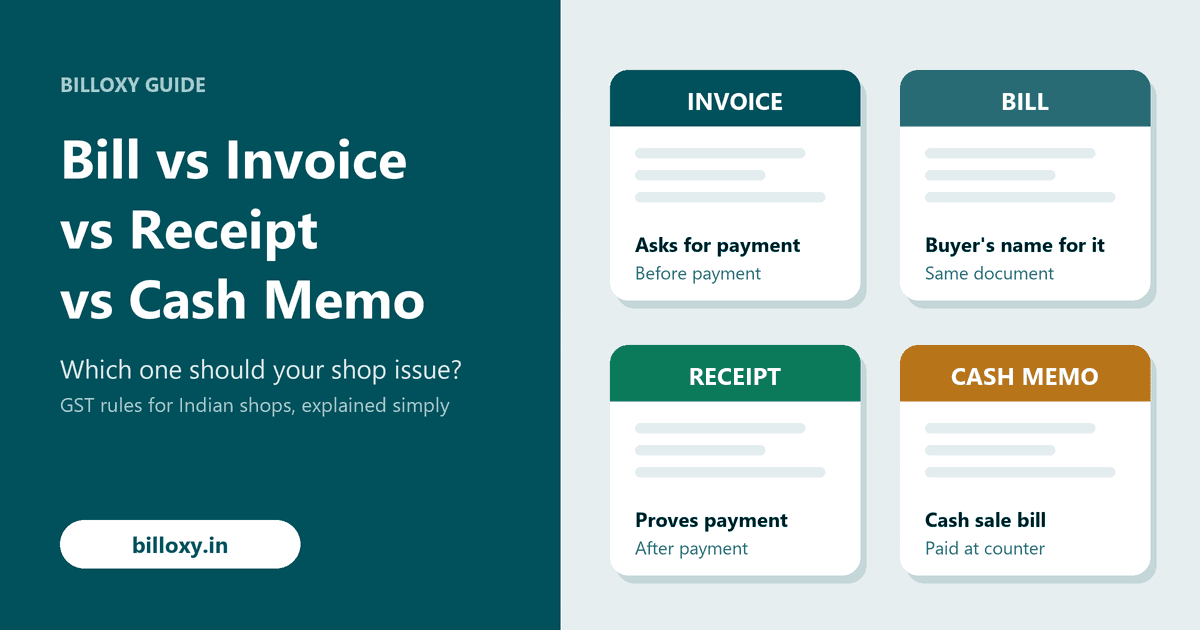
An invoice asks for payment and records the sale. A bill is the same document from the buyer's side; Indian shops use both words alike. A receipt proves money was paid. A cash memo is a bill for a cash sale. Under GST, a registered seller's bill must be a tax invoice or a bill of supply.
Bill every sale in the right format: start the 10-day free trial to create GST tax invoices and bills of supply on web or phone, or make a one-off bill now with the free GST invoice builder (no sign-up).
Updated 4 November 2026. Comparison criteria: who issues the document, when it is issued, what it proves, and what the GST law says about it. GST references are to the CGST Act, 2017 and the CGST Rules, 2017 as published by CBIC. This guide is general information, not tax or legal advice; check your own case with your CA.
Bill vs invoice vs receipt vs cash memo at a glance
| Invoice | Bill | Receipt | Cash memo | |
|---|---|---|---|---|
| What it says | "You owe me this amount for these goods or services" | "This is what I owe" (the buyer's word for the seller's invoice) | "I have received this payment" | "Cash sale: goods sold and paid for now" |
| Who issues it | Seller | Seller (the buyer calls it a bill) | Whoever received the money, usually the seller | Seller |
| When | At or before the sale or delivery | Same as the invoice | After payment is received | At the counter, at the time of a cash sale |
| Payment status | Usually unpaid; may carry a due date | Unpaid until settled | Paid | Paid |
| GST name, if the seller is registered | Tax invoice (section 31) | Tax invoice, or bill of supply if no GST is charged | A receipt for a payment; a receipt voucher if it is an advance before supply (Rule 50) | Not a separate GST document. It must meet the tax invoice or bill of supply rules |
| Main use in your books | Sales entry, GST output tax, customer dues | Purchase entry and input tax credit for the buyer | Proof that a due was cleared | Daily cash sales |
Is a bill the same as an invoice?
In most Indian shops, yes. When a customer asks for "the bill", they mean the document you would call an invoice. Accounting software and global guides draw a line by direction: you send an invoice to a customer, and you receive a bill from a supplier. It is one document, named from two sides:
- Your sales are invoices. They create receivables (money customers owe you).
- Your purchases are bills. They create payables (money you owe suppliers).
Some people also use "bill" for a document that is paid at once (a restaurant or retail bill) and "invoice" for one with credit terms (for example, payment in 30 days). Both readings are common; neither changes your GST duty.
What matters for GST is not the word printed at the top but whether the document has the details the law asks for. A "bill" with every Rule 46 field is a valid tax invoice. A document headed "Tax Invoice" that misses the GSTIN or the tax amounts is not.
What is the difference between an invoice and a receipt?
An invoice comes before payment and a receipt comes after it.
| Invoice | Receipt |
|---|---|
| Requests payment | Confirms payment |
| Shows items, quantities, rates, taxes and total | Shows the amount received, date, mode (cash, UPI, cheque, bank) and which invoice it settles |
| Creates a due in your books | Clears that due |
| Under GST, needed for every taxable sale by a registered seller (with one small-value exception, below) | Not a GST document in itself, except a receipt voucher for an advance |
For a counter sale that is paid on the spot, one printed bill usually does both jobs. The customer gets the tax invoice and pays at once, so the shop does not issue a separate receipt. For a credit sale, you issue the invoice on the day of sale and record a payment when the customer pays later, often as a part payment. A receipt for each payment helps both sides agree on the balance.
Advance payments. If a registered business takes money before it supplies, the GST law calls the document a receipt voucher. Rule 50 lists its details: supplier and recipient details, a serial number, date, description, the advance amount, the rate and amount of tax, and the place of supply for an inter-state supply.
What is a cash memo, and is it valid under GST?
A cash memo is the traditional small printed pad bill for a cash sale. It usually shows the shop name, a serial number, the date, items, quantities, rates and the total. "Cash memo" is a trade term. The GST law does not define it.
What the law asks depends on whether you are registered:
- Registered regular taxpayer: a cash sale is still a taxable supply, so your cash memo must work as a tax invoice: your GSTIN, a unique serial number, the HSN code where it applies, taxable value, the GST rate and amount, and a signature or digital signature. A plain pad memo without these is not enough.
- Registered composition dealer, or a seller of exempt goods or services: issue a bill of supply under section 31(3)(c). Rule 49 lists its details, and it shows no GST. See GST invoice vs bill of supply.
- Not registered under GST: you cannot charge GST, so your cash memo must not show any GST amount. A simple cash memo or bill is fine for your own records and your customer.
Small sales. Section 31(3)(b) and the provisos to Rule 46 let a registered seller skip a separate tax invoice for a sale under ₹200. This applies only when the buyer is not registered and does not ask for an invoice. The seller must then issue one consolidated tax invoice at the close of each day for all such sales. Rule 49 applies the same provisos to bills of supply.
Which document should you issue? Five common shop situations
| Situation | Issue this | Why |
|---|---|---|
| Walk-in customer pays cash or UPI for a ₹1,500 purchase; you are GST-registered (regular) | Tax invoice (your "bill" or "cash memo" in tax invoice format) | Taxable sale above ₹200 |
| Same shop, a ₹120 sale, and the customer does not want a bill | No separate invoice; include it in the day's consolidated tax invoice | Section 31(3)(b) and the Rule 46 provisos |
| Wholesaler supplies a registered retailer on 30 days' credit | Tax invoice with the retailer's GSTIN, then record each payment against it | The buyer needs the invoice for input tax credit; your payment entries show the balance |
| Composition dealer sells to anyone | Bill of supply | Composition dealers cannot charge GST |
| A caterer takes ₹10,000 advance for an event next month | Receipt voucher now, tax invoice when the service is supplied | Rule 50 receipt voucher for the advance |
Two other documents are easy to confuse with these. A proforma invoice is a quote-style document before a sale and creates no tax. A delivery challan moves goods without a sale (job work, approval, branch transfer). Neither replaces the tax invoice.
Why does the right document matter for a small business?
- Your customer's input tax credit. A registered buyer can claim GST paid on purchases only with a valid tax invoice, and when the supplier has reported it. A pad memo without your GSTIN and tax split can cost your B2B customers their credit, and with it, their business.
- Clean dues. Separating invoices (what is owed) from payments (what came in) is how you know each customer's balance. Mixing them on loose memos is the usual cause of "I already paid that" disputes.
- GST returns. Your tax invoices feed your outward supplies in GSTR-1. Numbered, complete invoices make the monthly return a summary, not a hunt through pads.
- Fewer counter mistakes. Hand-written memos are where wrong totals, missing serial numbers and wrong tax rates creep in. Our list of common invoice mistakes shows the usual ones.
Can you keep using a handwritten cash memo book?
Yes, if every memo carries the details your registration type requires and the serial numbers stay unique for the financial year. Many small shops still do. The problems start when sales grow: copying item rates and HSN codes by hand, working out CGST and SGST on every line, and later typing the whole pad into a return or a spreadsheet. That is the point where most owners move to a GST invoice format in software, or a billing app on the phone.
How Billoxy helps
Billoxy is GST billing, invoicing and inventory software for Indian MSMEs, on web and mobile (Android now; Apple coming soon).
- Tax invoices and bills of supply from the same billing flow, on the web or on your phone at the counter. CGST, SGST or IGST is applied line by line on the GST feature.
- Payments against invoices. Record what each customer pays in Payment In, including part payments, and see who still owes you. Billoxy Reminder can flag pending and overdue bills.
- Purchases as bills. Supplier bills go into purchases, so payables and stock stay in the same place as your sales. See the inventory feature.
- Proforma invoices and delivery challans are among the documents Billoxy's onboarding guide lists, alongside sales, purchase, orders, expenses, and credit and debit notes.
Invoice creation takes under 5 seconds once your items and customers are saved. Start the 10-day free trial and replace the memo pad with numbered GST bills, or try the free GST invoice builder for a single bill.
Frequently asked questions
Is a bill and an invoice the same thing in India?
In daily use, yes: a shop's "bill" is its invoice. In accounting, an invoice is what you send to customers, and a bill is what you receive from suppliers. For GST, the name does not matter. A registered seller's document must contain the tax invoice details in Rule 46, or the bill of supply details in Rule 49.
Can an invoice be used as a receipt?
When the customer pays at the time of sale, the invoice usually serves both purposes and many businesses mark it "Paid". For credit sales, record each payment separately against the invoice. A receipt for each payment is good practice, so both sides agree on the balance.
Is a cash memo valid for GST input tax credit?
Only if it meets the tax invoice requirements: the supplier's GSTIN, a unique serial number, the buyer's GSTIN, taxable value, the GST rate and amount, and the other Rule 46 details. A plain cash memo without these does not support an input tax credit claim.
Does a shop have to give a bill for every sale?
A GST-registered seller must issue a tax invoice (or a bill of supply) for each supply. The exception is a sale under ₹200 to an unregistered buyer who does not ask for one. Those sales go into one consolidated tax invoice at the end of the day.
What is the difference between a receipt and a receipt voucher?
A receipt is any acknowledgement that money was received. A receipt voucher is the GST document under Rule 50 that a registered supplier issues when it receives an advance before making the supply. It shows the advance amount and the tax on it.
Should an unregistered shop show GST on its bills?
No. Only a registered person can collect GST. An unregistered shop's bill or cash memo must not show any GST amount.
Related Billoxy guides
- GST invoice format: every Rule 46 field
- GST invoice vs bill of supply
- What is a proforma invoice?
- Delivery challan format
- Payment reminder messages for shop owners
- Billing software for retail stores
Sources
- Rule 46, CGST Rules: Tax invoice, CBIC (read 4 November 2026)
- Rule 49, CGST Rules: Bill of supply, CBIC (read 4 November 2026)
- Rule 50, CGST Rules: Receipt voucher, CBIC (read 4 November 2026)
- Section 31 (tax invoice, bill of supply, receipt voucher) and section 32 (prohibition of unauthorised collection of tax), CGST Act, 2017, on cbic-gst.gov.in