
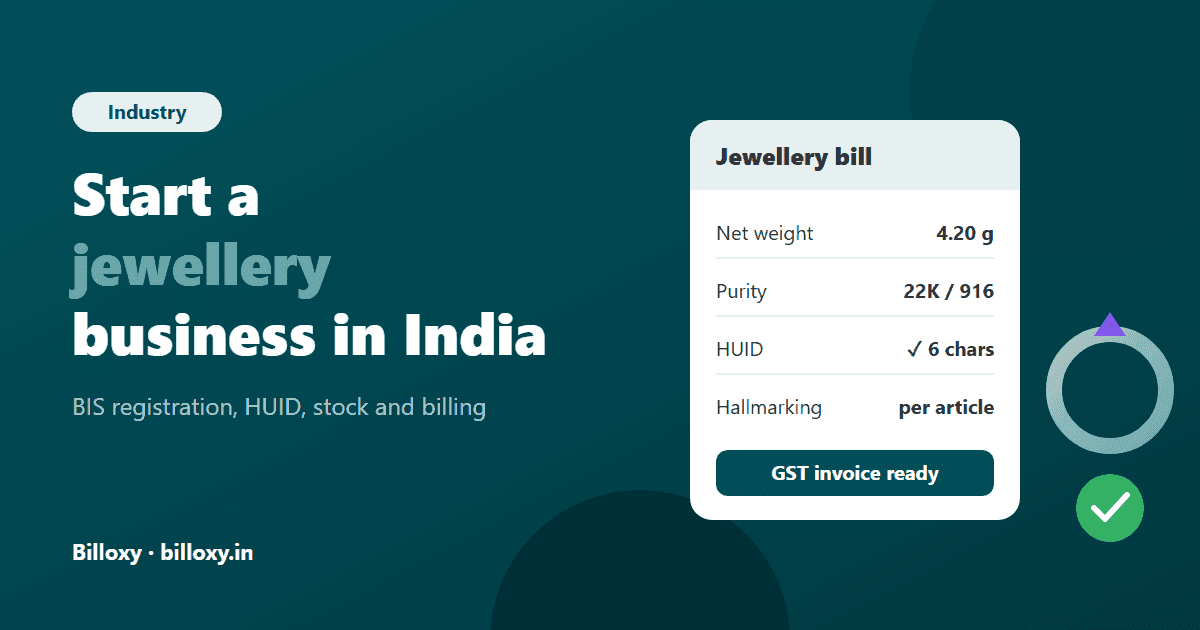
To start a jewellery business in India, pick a format (gold showroom, goldsmith, silver or imitation jewellery), register the shop and for GST when required, and register as a jeweller with BIS before selling hallmarked gold. Then buy stock you can track piece by piece, and bill each sale with the weight, purity and hallmarking details BIS requires.
Updated 23 November 2026. This guide is for people opening a jewellery shop in India and for goldsmiths, silver sellers and imitation-jewellery sellers who want to run a proper counter. It covers the business choices, registrations, BIS hallmarking and HUID, buying and tracking stock, and what a jewellery bill must show. Hallmarking rules are amended often and differ by district, so check the BIS sources linked here before you act. This is not legal or tax advice.
If you are setting up billing for a new jewellery shop, you can start the 10-day trial or see how Billoxy works for jewellery stores.
Which type of jewellery business should you start?
The format decides how much money you tie up, which rules apply to you and how you bill. Decide it first.
| Format | What you sell | Money tied up in stock | Hallmarking applies? | Main paperwork | Fits best if you |
|---|---|---|---|---|---|
| Gold and silver showroom | Ready gold and silver jewellery bought from manufacturers or wholesalers | Very high: gold is priced by weight | Yes for gold in covered districts; HUID-based silver hallmarking is voluntary | GST, BIS jeweller registration, shop registration, purchase bills | Have capital, a trusted location and supplier contacts |
| Small gold shop or goldsmith (making and selling) | Custom orders, repairs, small ready range | Medium: gold for orders, often from the customer's old gold | Yes, when you sell hallmarked gold | BIS registration, GST, job-work and order records | Have craft skills and local customers who order for weddings |
| Silver and gift jewellery shop | Silver jewellery, anklets, utensils, gift items | Medium | Voluntary HUID hallmarking for silver (see below) | GST, shop registration | Want lower capital than gold |
| Imitation or fashion jewellery (shop or online) | Artificial, oxidised, kundan-style pieces with no precious metal | Low | No: hallmarking is for gold and silver articles | GST when it applies, marketplace seller registration if online | Want to start small and test designs fast |
Verdict. If you do not yet have gold capital or supplier trust, start with silver or imitation jewellery, or as a goldsmith taking orders, and add a gold showroom range later. A gold showroom is the biggest commitment: stock is expensive, every piece must be weighed and recorded, and BIS rules apply at the counter.
What does a jewellery shop need before opening?
Most of these are the registrations any shop needs. The BIS jeweller registration is the one that is special to jewellery.
- GST registration. You must register once your turnover crosses the threshold that applies to you, and earlier in some cases (for example some inter-state sales or sales through e-commerce operators). Once registered, you issue GST invoices with HSN codes. Jewellery is under HSN 7113 (articles of jewellery); see what an HSN code is in GST billing. If you choose the composition scheme where eligible, you issue a bill of supply instead; see the GST composition scheme.
- BIS registration as a jeweller. Required to sell hallmarked gold and silver jewellery. BIS says the jeweller applies online through the National Single Window System (NSWS). The one-time registration is granted instantly, with no registration fee and lifetime validity, and the certificate can be downloaded from the portal. A business with several outlets can use corporate registration, where the head office applies with the list of outlets (BIS brief on hallmarking, read 23 November 2026).
- Shop and establishment registration. This is a state law, so the name and the steps depend on your state. Many cities also ask for a municipal trade licence. Our clothing business guide shows how this works in Maharashtra as an example.
- Udyam registration on the Ministry of MSME's Udyam portal, if you want to be recognised as a micro or small enterprise. It is free.
- A current account and UPI collection in the business name, so that payments for high-value sales are easy to match with bills.
What is BIS hallmarking and HUID, and does it apply to your shop?
Hallmarking is the official testing and marking of how much precious metal an article contains. In India, BIS runs the scheme for gold and silver. A registered jeweller sends articles to a BIS-recognised Assaying and Hallmarking Centre (AHC), which weighs and tests them and marks the ones that meet the standard.
HUID (Hallmark Unique Identification) is a six-digit alphanumeric code. Since 1 July 2021, a gold hallmark has three parts: the BIS standard mark, the purity in carat and fineness, and the HUID. Customers can check an HUID with the "Verify HUID" feature of the BIS Care app.
Where it is mandatory. Mandatory hallmarking of gold jewellery and artefacts started on 23 June 2021 in 256 districts. BIS says coverage has since grown to 392 districts, as per the latest amendment dated 3 August 2026. Whether hallmarking is compulsory for your shop depends on your district, so check the BIS list of covered districts before you open.
Purity grades. Gold jewellery is hallmarked in seven grades, each with a minimum fineness in parts per thousand:
| Carat | 9K | 14K | 18K | 20K | 22K | 23K | 24K |
|---|---|---|---|---|---|---|---|
| Minimum fineness | 375 | 585 | 750 | 833 | 916 | 958 | 995 |
Exemptions. BIS lists exemptions that apply subject to conditions, including gold articles below 2 grams, Kundan, Polki and Jadau articles, some export and exhibition cases, and gold thread. Read the current order and BIS guidelines before you rely on one.
Silver. From 1 September 2025, HUID-based hallmarking of silver jewellery is voluntary. But any silver article you send for hallmarking under the BIS scheme must carry the HUID-based hallmark: the BIS mark with the word "SILVER", the purity grade and the HUID.
What changed in September 2026. The BIS (Hallmarking) Amendment Regulations, 2026, published on 14 September 2026, set the hallmarking fee a jeweller pays the AHC at ₹75 per gold article (minimum ₹200 per consignment) and ₹35 per silver article (minimum ₹150 per consignment), plus applicable taxes. Add this cost when you price a hallmarked piece.
Hallmarking coverage differs by district
Hallmarking rules are central, but whether they are compulsory depends on where your shop is. BIS adds districts by amendment, so a shop that was outside the list last year may be inside it now.
| Your situation | What to do |
|---|---|
| Your district is in the BIS list | Register with BIS before you sell gold jewellery, and sell only hallmarked gold unless an exemption applies |
| Your district is not in the list yet | You can still register and sell hallmarked jewellery; check the list after each amendment |
| You have outlets in several districts or states | Check each district, or use BIS corporate registration that lists all outlets |
| You sell online to other states | Check the rules for your own district and keep hallmark details on every bill |
Source: BIS phase-wise coverage of districts and the Hallmarking Order amendments on the BIS hallmarking page (read 23 November 2026).
How do you choose suppliers and buy opening stock?
Gold stock is bought and valued by weight and purity, not by piece count, so buying needs more care than in most shops.
- Start with fewer designs in the purities your customers buy. Ask other jewellers in your market and your first customers before you stock widely.
- Buy from registered suppliers with proper purchase bills that show the weight, purity and hallmark details. These bills are your proof of what you hold.
- Weigh and check every piece when it arrives. Record gross weight, net metal weight and purity against the purchase bill before the piece goes into the showcase.
- Give every piece a tag number. A tag that links to your stock record makes counting, selling and finding a piece much easier.
- Keep a separate record for customers' old gold that you take in exchange or for remaking. Write what you received, its weight and purity, and what it was adjusted against.
- Plan cash for price swings. Gold prices move, and stock bought at one price may sell at another. Keep working capital separate from stock money.
How should a jewellery shop track stock?
Every piece is valuable, so a small gap between your record and your showcase is a real loss. A simple routine:
- Daily: count the pieces taken out for customers and put back, by tag number. Match the day's bills against the pieces that left.
- Weekly: count one section in full (for example all chains) and compare it with the stock record by tag number and weight.
- Monthly: do a full count of every section and value it. Our guide to closing stock for small shops explains how to value stock at the lower of cost and net realisable value.
- Before the wedding season: see which designs and weights sold last season and re-order those first, rather than adding many new designs. The stock management guide shows how to set reorder levels.
Register or software? A bound stock register works when you have a few hundred pieces and one person updates it. Once you have more pieces, several staff or more than one counter, it gets hard to match the register with sales. Software that records every purchase and sale against the item keeps the stock balance up to date without a separate entry. See inventory management in Billoxy.
What should a jewellery bill include?
A jewellery bill must work as a GST invoice and also meet BIS requirements for hallmarked articles. BIS says the sale invoice must show, for each article (BIS brief on hallmarking, read 23 November 2026):
- a separate description of each article
- the net weight of the precious metal
- the purity in carat and fineness
- the hallmarking charges
- a line saying that the customer can get the purity verified at any BIS-recognised AHC
BIS says this applies to retail sales and to jeweller-to-jeweller (B2B) sales.
On top of that, a GST invoice carries your GSTIN, invoice number and date, the customer's details where required, the HSN code, the taxable value and the GST amount. Many jewellers also show making charges, stone value and any old-gold adjustment as separate lines, so the customer can see how the total was reached. Ask your accountant how GST applies to each of those lines in your case.
A sample layout for one line of a jewellery bill (illustrative figures, not real rates or prices):
| Article | HSN | Gross wt (g) | Net metal wt (g) | Purity | HUID | Metal value (₹) | Making (₹) | Hallmarking (₹) | Taxable value (₹) |
|---|---|---|---|---|---|---|---|---|---|
| Gold ring, plain | 7113 | 4.20 | 4.20 | 22K / 916 | (6-character code) | (rate × net wt) | (as agreed) | 75 | (total) |
Add the GST lines below the table, then a note: "Purity of hallmarked articles can be verified at any BIS-recognised Assaying and Hallmarking Centre."
For the difference between a bill, an invoice and a receipt, see bill vs invoice vs receipt. To try a GST invoice layout without signing up, use the free invoice tool.
Before the wedding season: a counter checklist
Wedding season brings the largest orders of the year to most jewellers, and many of them are booked weeks in advance. Before it starts:
- Confirm your BIS registration and your district's status, and make sure the BIS display and the 10X magnifying glass and weighing balance BIS asks for are at the counter.
- Send pieces for hallmarking early. AHC queues can grow before the season, and the fee is per article.
- Prepare quotations for bridal sets with weight, purity and making charges written down, so the customer can compare and you can convert the order to an invoice later. A quotation format helps.
- Record advance payments against each order and keep the balance visible, so nothing is missed at delivery.
- Re-order the weights and designs that sold last season first.
- Agree an old-gold exchange process with your staff: weigh, test, write it on a receipt and adjust it on the final bill.
Showroom, goldsmith or imitation: which suits a first-time owner?
| Criteria | Gold showroom | Goldsmith (orders and repairs) | Imitation jewellery |
|---|---|---|---|
| Starting capital | Highest | Medium | Lowest |
| BIS registration needed | Yes, to sell hallmarked gold | Yes, when selling hallmarked gold | No |
| Stock risk | Price swings on large stock | Lower: much is made to order | Design going out of fashion |
| Billing detail | Weight, purity, HUID, hallmarking charges on each article | Same, plus order and old-gold records | Simple GST invoice |
| Wedding-season dependence | High | High | Medium |
Verdict. A goldsmith with local trust can grow into a showroom. A first-time owner without gold capital should start with imitation or silver jewellery and learn the market first. A showroom is right only when you have capital, supplier trust and a clear plan for BIS compliance at the counter.
What are common mistakes when starting a jewellery business?
- Opening without checking the district list, then finding that hallmarking is compulsory where the shop is.
- Writing bills without net weight or purity, which BIS requires for hallmarked articles.
- Mixing customers' old gold with shop stock in one record.
- Not counting stock by tag number, so a missing piece is noticed only at the year-end count.
- Taking wedding orders on paper slips, then losing track of advances and delivery dates.
- Pricing without the hallmarking fee, which is charged per article.
Checklist: opening a jewellery shop
- Choose the format and the purities you will stock
- Get the shop and establishment registration your state requires
- Register for GST when it applies, and note HSN 7113 for jewellery
- Register with BIS as a jeweller through NSWS
- Check whether your district is in the BIS mandatory-hallmarking list
- Set up the BIS display, magnifier and weighing balance at the counter
- Find suppliers who give proper purchase bills with weight and purity
- Tag every piece and set up a stock record by tag number
- Prepare a bill format with net weight, purity, hallmarking charges and the AHC verification line
- Open a current account and UPI collection in the business name
How Billoxy helps a jewellery shop
Billoxy is GST billing, invoicing and inventory software for Indian MSMEs. For a jewellery shop, the jewellery stores page describes:
- GST-ready invoices with the applicable tax calculated, so high-value bills don't depend on manual calculation.
- Quotations for custom or high-value pieces that you can convert into GST invoices when the order is confirmed.
- Cash, card, UPI and part payments recorded against a single sale, with each customer's billing history and dues.
- Jewellery stock records by product and category, stock movement and help with physical stock reconciliation. See inventory management.
- Supplier records, purchase history and supplier dues in one place, and multi-store management from one dashboard.
When you want a quick look at the business from the counter or on the road, the Billoxy mobile dashboard shows your sales trend, which customers have gone quiet, and what customers owe you, and you can ask Billoxy AI about any card in plain words. At month end, the Report Center puts your reports on one screen, with print and CSV download for your CA.
Billoxy's documented features do not include HUID or hallmark recording, so keep hallmark details as BIS requires on your bills and records.
Ready to set up billing for your shop? Start the 10-day free trial or see plans and pricing.
Questions people ask about starting a jewellery business
Is BIS registration compulsory to open a jewellery shop?
You need BIS registration as a jeweller to sell hallmarked gold and silver jewellery. In districts where gold hallmarking is mandatory, that means a gold jeweller must register before selling gold jewellery, unless an exemption applies. Imitation jewellery, which has no gold or silver, does not need it.
What is HUID on gold jewellery?
HUID (Hallmark Unique Identification) is a six-digit alphanumeric code in the hallmark. Since 1 July 2021, a gold hallmark shows the BIS mark, the purity in carat and fineness, and the HUID. Customers can verify it with the BIS Care app.
How many districts have mandatory gold hallmarking?
BIS says mandatory hallmarking started in 256 districts on 23 June 2021 and covers 392 districts as per the amendment dated 3 August 2026. Check the BIS phase-wise district list for your district, because more districts are added by amendment.
What must a jewellery bill show under BIS rules?
For hallmarked articles, BIS requires a separate description of each article, the net precious-metal weight, the purity in carat and fineness, the hallmarking charges, and a line that the customer can get the purity verified at any BIS-recognised AHC. This applies to retail and B2B sales.
How much is the hallmarking fee per piece?
From the BIS (Hallmarking) Amendment Regulations, 2026 (14 September 2026), a jeweller pays the AHC ₹75 per gold article with a minimum of ₹200 per consignment, and ₹35 per silver article with a minimum of ₹150 per consignment, plus applicable taxes.
Related guides
- How to start a clothing business in India
- Stock management for small shops
- Closing stock: meaning, formula and how to calculate it
- Quotation format
Sources
- BIS: Hallmarking overview and Brief on Hallmarking Scheme: Bureau of Indian Standards (read 23 November 2026)
- Hallmarking of Gold Jewellery and Gold Artefacts (Third Amendment) Order, 2026: S.O. 4345(E), 3 August 2026
- BIS phase-wise coverage of districts under gold mandatory hallmarking
- Bureau of Indian Standards (Hallmarking) Amendment Regulations, 2026: 14 September 2026 (hallmarking fee)
- Udyam Registration: Ministry of MSME
- GST portal and CBIC GST: registration and rate notifications