
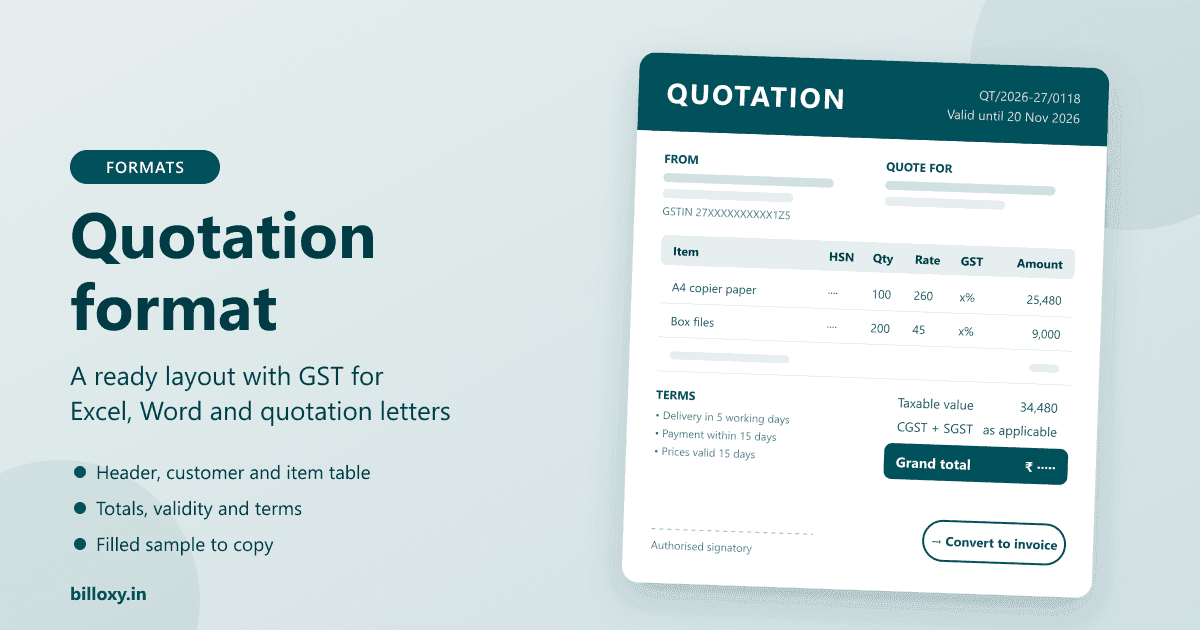
A quotation format is the layout of the price offer you send a customer before they buy. A good one shows your business and GSTIN, a quotation number and date, the customer, an item table with rate, discount and GST, the total, a validity date, payment and delivery terms, and a signature. GST law does not prescribe a quotation format, so you can use any layout that shows these clearly.
Send quotations without retyping: Billoxy's Quotation & Proforma module builds the quote from your saved items and customers, and converts it to a sales invoice when the customer says yes. Start the 10-day free trial, or copy the layout below into Excel, Word or your letterhead.
Updated 5 November 2026. This guide is for Indian traders, wholesalers, contractors, service providers and shop owners who give prices before an order. It gives a layout you can copy, a filled sample, variations for goods, services and quotation letters, and the mistakes that cost orders. It is general information, not tax advice.
What is a quotation?
A quotation (or quote) is a document in which a seller tells a buyer what it will supply, at what price and on what terms, for a limited time. The buyer compares it with other quotes and replies with an order, a negotiation, or nothing. It is an offer, not a bill: no sale has happened, no payment is due, and it does not go into your GST returns.
The document that comes after a quotation is usually a purchase order from the buyer, sometimes a proforma invoice from you, and finally the tax invoice when the goods or services are supplied.
What does a quotation format look like?
A quotation has five blocks, top to bottom. Copy this layout into a spreadsheet, a Word table or your printed letterhead.
Block 1: header
| Field | What to write |
|---|---|
| Title | "Quotation" (or "Price Quotation" / "Estimate") |
| Your business | Name, address, phone, email |
| Your GSTIN | Your 15-character GSTIN, if you are registered |
| Quotation number | Your own series, for example QT/2026-27/0118. Keep it separate from your tax invoice series |
| Quotation date | The date you send it |
| Valid until | The last date the prices hold, for example 15 or 30 days from the quotation date |
Block 2: customer
| Field | What to write |
|---|---|
| Customer name and address | The business or person asking for the price |
| Customer GSTIN | If registered; it tells you whether the final bill will be B2B |
| Contact person | Who asked for the quote |
| Customer's reference | Their enquiry number, tender number or email date, if any |
| Delivery or site location | Where the goods go or the work is done; it decides CGST + SGST or IGST on the final bill |
Block 3: item table
| Sr. | Description | HSN / SAC | Qty | Unit | Rate (₹) | Discount | Taxable value (₹) | GST rate | GST amount (₹) | Amount (₹) |
|---|---|---|---|---|---|---|---|---|---|---|
| 1 | ||||||||||
| 2 |
If you are GST-registered, show the rate and the tax so the buyer sees the full cost. Use the GST rate of each item from your item master or the official rate notification, not a guess. Write "GST extra as applicable" only if you truly cannot show the rate yet; buyers compare quotes on the final price, and a quote without tax looks cheaper than it is.
Block 4: totals
| Line | Amount (₹) |
|---|---|
| Total taxable value | |
| CGST + SGST (same state) or IGST (other state) | |
| Freight / packing / installation, if charged | |
| Round off | |
| Grand total | |
| Amount in words |
Block 5: terms and signature
- Validity: "Prices valid until <date>."
- Payment terms: advance, on delivery, or credit days (for example "50% advance, balance within 15 days of invoice").
- Delivery time: "Within 7 working days of confirmed order."
- Freight and installation: included or extra.
- Warranty or service terms, if any.
- Bank details for an advance, if you ask for one.
- "For <your business name>", authorised signatory, and seal if you use one.
What is a sample quotation?
Here is a filled example with sample figures.
A stationery wholesaler in Maharashtra quotes a school in the same state for printer paper and files.
| Field | Entry |
|---|---|
| Quotation number and date | QT/2026-27/0118, 5 November 2026 |
| Valid until | 20 November 2026 |
| Customer | The school's name, address and contact person |
| Item 1 | A4 copier paper, 75 gsm, 100 reams × ₹260 = ₹26,000 |
| Item 2 | Box files, 200 pieces × ₹45 = ₹9,000 |
| Discount | 2% on item 1 (₹520) |
| Taxable value | ₹34,480 |
| GST | At each item's rate from the wholesaler's item master, split into CGST and SGST because the school is in the same state |
| Terms | Delivery in 5 working days; payment within 15 days of invoice; free delivery within city limits |
The figures are only an example. The GST rate for each item comes from your own item master and the official rate notification.
How do you write a quotation, step by step?
- Read the enquiry fully. Note the exact item, size, brand, quantity and delivery place the customer asked for.
- Work out your price. Start from cost, add your margin, then any freight or installation. Our guide to markup vs margin shows how to set a selling price that leaves the profit you expect.
- Fill the header and customer blocks, with a new quotation number from your series.
- Fill the item table with HSN or SAC, rate, discount and GST for each line.
- Check the totals and write the amount in words.
- Add validity, payment and delivery terms. A quotation without terms invites disputes later.
- Sign and send it as a PDF by email or WhatsApp, and note the date you sent it.
- Follow up before the validity date. Many quotes are lost simply because nobody called back.
Quotation format for goods, services, and as a letter
The five blocks stay the same. What changes is the item table and the terms.
| Type | What to change in the format |
|---|---|
| Goods (traders, wholesalers, shops) | HSN code, quantity and unit, freight and packing lines, delivery time |
| Services (repairs, IT, consulting, cleaning) | SAC code, scope of work in place of quantity, hours or visits, milestones for payment |
| Contract or installation work | Separate lines for material and labour, site address, completion time |
| Quotation letter | A short covering letter on your letterhead: "Dear Sir/Madam, with reference to your enquiry dated <date>, we are pleased to quote as below", then the item table and terms, then the signature |
| Estimate for a retail customer | A simpler table (item, qty, rate, amount), the total with GST, and "valid for 7 days" |
Quotation vs proforma invoice vs tax invoice: what is the difference?
| Point | Quotation | Proforma invoice | Tax invoice |
|---|---|---|---|
| When | Before the buyer decides | After the buyer intends to buy, before supply | When the goods or services are supplied |
| Purpose | Offer a price | Confirm the terms, ask for an advance | Bill the sale |
| What it is | An offer the buyer can accept | A commercial document, not a tax invoice | A tax document |
| Reported in GSTR-1 | No | No | Yes |
| Buyer can claim input tax credit | No | No | Yes, from a correct invoice |
The proforma invoice guide covers the middle step in detail.
Excel, Word, a printed pad or billing software: which should I use?
| Option | Good for | Watch out for |
|---|---|---|
| Printed quotation pad | A few quotes a month, walk-in customers | No copy you can search; totals by hand |
| Excel or Word template | Occasional quotes, custom layouts | Quotation numbers repeat or skip; rates and GST typed each time; the final invoice is typed again |
| Billing software with quotations | Regular quotes, repeat customers, quotes that turn into orders | Monthly cost after the trial; a short setup of items and parties |
A template is fine when you quote now and then. If you send quotes every day, the real work is not the layout but tracking which quotes are still open, which ones expire this week, and making the final bill match what you promised.
Common mistakes in a quotation
- No validity date. Old prices get held against you when costs rise.
- GST left out or written as "extra" without a rate. The buyer's real cost is unclear and the comparison goes against you later.
- Using the tax invoice number series. Keep quotations in their own series so your invoice numbers stay consecutive.
- Vague items. "Paper, 100" leads to arguments; write size, grade, brand and unit.
- No payment or delivery terms, so the buyer assumes the best case.
- Retyping the quotation into the invoice, where quantity, rate and GST errors creep in.
- No follow-up before the quote expires.
How Billoxy helps
Billoxy is GST billing, invoicing and inventory software for Indian MSMEs, on web and mobile. Its Quotation & Proforma module keeps the documents before the bill in one place:
- Create a quotation for a customer with the item's sales price, tax, discounts and totals, using the same logic as a sales order.
- Preview it in a PDF template, then download, print, or share it by WhatsApp or email.
- Keep the document date and the due or validity date on the quote.
- Convert the quotation to a sales invoice when the customer confirms, so the customer, items, prices, tax and totals carry over instead of being typed again.
- Set reminders 3 days before, on, and 1 day after the due date through WhatsApp, SMS and email.
Your saved items carry their HSN codes and GST rates through the inventory feature, and the final sales invoice applies CGST, SGST or IGST line by line. Invoice creation takes under 5 seconds once your items and customers are saved.
Start the 10-day free trial to keep quotations, invoices and stock in one place. If you only need one GST invoice right now, the free GST invoice generator builds one without signing up.
Frequently asked questions
Is there a government-prescribed quotation format in India?
No. GST rules prescribe what a tax invoice must contain, not a quotation. Any clear layout works if it shows your details, the customer, the items with price and tax, the total, the validity and the terms.
Should a quotation include GST?
If you are GST-registered, yes: show the GST rate and amount for each item, or at least the total tax, so the buyer knows the full price. If you are not registered, do not charge or show GST.
Is a quotation a legal document?
It is an offer. When the buyer accepts it, usually with a purchase order, the quotation's prices and terms become part of the deal. It is not a tax document and is not reported in GST returns.
How long should a quotation be valid?
There is no fixed rule. Fifteen or thirty days is common; use a shorter period when your purchase costs change often.
What is the difference between a quotation and an estimate?
They are often used to mean the same thing. In practice, an estimate is an approximate price that may change, while a quotation is a fixed price for the stated scope and validity period.
Can I make a quotation in Excel or Word?
Yes. Copy the five blocks above into a sheet or a table, keep your own quotation number series, and save each quote as a PDF before sending it.
Related Billoxy guides
- What is a proforma invoice?
- GST invoice format
- Delivery challan format
- Purchase order format with GST
- Bill vs invoice vs receipt
- Payment reminder messages
- Markup vs margin for shop owners
Official sources
- Rule 46, CGST Rules — Tax invoice — CBIC (the fields the final invoice needs; there is no equivalent rule for quotations)
- GST rate notifications — CBIC (check each item's rate here)