
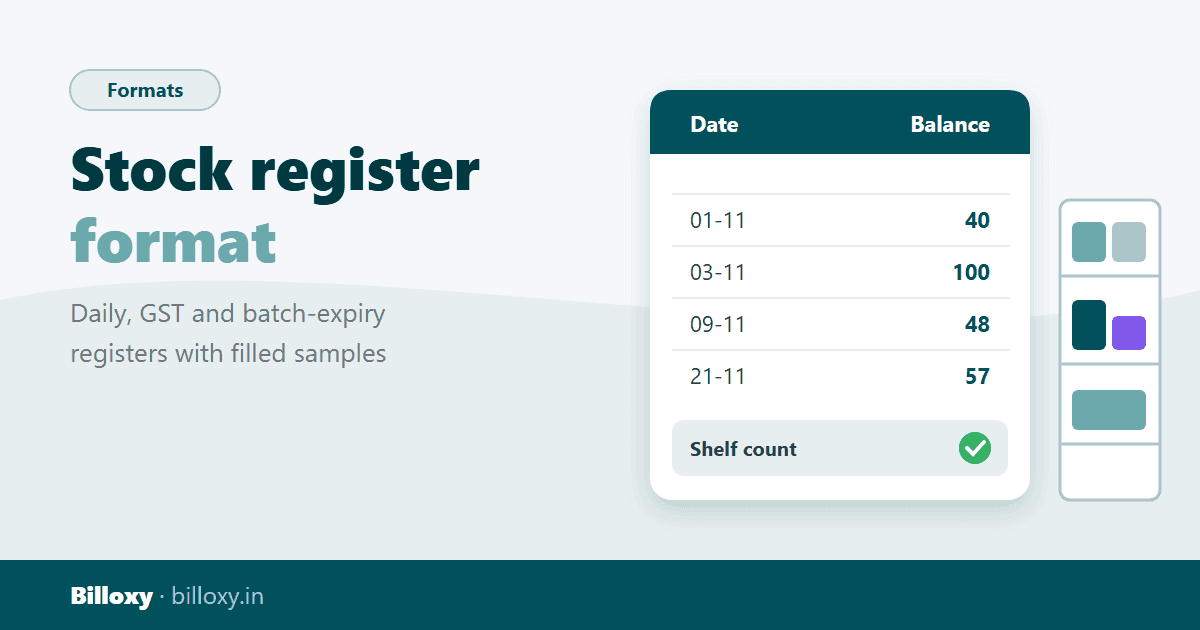
A stock register format is a table that records, for each item, the opening stock, goods received, goods sold or issued, and the closing stock: opening + received − issued = closing. A shop's register uses Date, Particulars, Bill number, In, Out and Balance columns. GST-registered businesses also record goods lost, written off or given free.
Updated 27 November 2026. This guide is for owners and store staff at Indian shops, wholesalers and distributors: kirana and grocery stores, medical stores, mobile and electronics shops, hardware and clothing shops. It gives four copyable layouts, each with a filled sample. In Hindi, a stock register is called a स्टॉक रजिस्टर or माल का रजिस्टर (maal ka register).
If you rebuild stock in Excel from your bills every week, you can start the 10-day trial and open the Stock Summary in Report Center instead.
What is a stock register, and which format do you need?
A stock register (also called a stock book or stock account) holds one page, or one block of rows, per item. Every time goods come in (purchase, customer return) or go out (sale, purchase return, damage, free sample), you add a line and work out the new balance. At any moment the last balance should match what is on the shelf.
| Format | Columns | Best for |
|---|---|---|
| 1. Item-wise stock register | Date, Particulars, Bill / voucher no., Received, Issued, Balance | Every shop; one page per item |
| 2. Daily stock register (summary) | Item, Opening, Received, Sold, Closing, for one day | Daily counter check, bakeries, grocery and fast-moving stock |
| 3. GST stock register (stock account) | Opening, Receipts, Supplies, Lost / stolen / destroyed, Written off, Gift / free sample, Balance | GST-registered businesses (Rule 56(2) of the CGST Rules) |
| 4. IMEI / serial and batch-expiry register | Item, IMEI or serial or batch no., Mfg. and expiry date, Purchase bill, Sale bill | Mobile, electronics and medical stores |
Stock register format 1: item-wise register with running balance
This is the basic format. Keep one block per item, with the unit (pieces, kg, boxes) written at the top. "Received" includes purchases and returns from customers. "Issued" includes sales, returns to the supplier and anything damaged or used in the shop.
Sample: wheat atta, 5 kg pack (unit: packs) at a kirana store, November 2026
| Date | Particulars | Bill / voucher no. | Received | Issued | Balance |
|---|---|---|---|---|---|
| 01-11-2026 | Opening stock | — | — | — | 40 |
| 03-11-2026 | Purchase from Gupta Traders | PB-212 | 60 | — | 100 |
| 03-11-2026 to 09-11-2026 | Sales (counter bills) | S-1401 to S-1530 | — | 52 | 48 |
| 10-11-2026 | Customer return (torn pack) | CN-18 | 1 | — | 49 |
| 11-11-2026 | Returned to supplier (torn pack) | DN-4 | — | 1 | 48 |
| 12-11-2026 to 20-11-2026 | Sales (counter bills) | S-1531 to S-1702 | — | 31 | 17 |
| 21-11-2026 | Purchase from Gupta Traders | PB-240 | 40 | — | 57 |
Check: opening 40 + received 101 − issued 84 = balance 57. Count the shelf; if it shows 55, there is a shortage of 2 packs to explain. Figures are illustrative. You can write each sale bill on its own line, or total a few days of sales as above, as long as the bill numbers are recorded.
Stock register format 2: daily stock register for the counter
A daily stock register puts all fast-moving items on one page for one day. It is the quickest way to spot a shortage the same evening, before it becomes a month-end mystery.
Sample: daily stock register, a grocery store, 21 November 2026
| Item | Unit | Opening | Received | Sold | Closing (books) | Physical count | Difference |
|---|---|---|---|---|---|---|---|
| Toor dal 1 kg | packs | 34 | 24 | 19 | 39 | 39 | 0 |
| Sunflower oil 1 L | pouches | 48 | 0 | 22 | 26 | 25 | −1 |
| Sugar (loose) | kg | 85 | 50 | 41 | 94 | 93.5 | −0.5 |
| Bath soap 4-pack | packs | 20 | 12 | 9 | 23 | 23 | 0 |
Closing (books) = Opening + Received − Sold. A small difference on loose goods such as sugar can come from weighing. A missing pouch of oil is worth checking against the day's bills before the shop closes.
Stock register format 3: GST stock account (Rule 56(2))
Under Rule 56(2) of the CGST Rules, every registered person, other than a person paying tax under section 10 (the composition scheme), must keep stock accounts for goods received and supplied. The account must show the opening balance, receipt, supply, goods lost, stolen, destroyed, written off or disposed of as a gift or free sample, and the balance of stock, including raw materials, finished goods, scrap and wastage. The rule does not prescribe a fixed form, so the columns below simply give each of those particulars its own place.
Layout and sample: LED bulb 9W (unit: pieces), an electrical and hardware shop, October 2026
| Particular (Rule 56(2)) | Quantity | Reference |
|---|---|---|
| Opening balance (1 Oct 2026) | 120 | Closing balance of September |
| Receipts (purchases, customer returns) | 300 | PB-88, PB-97, CN-11 |
| Supplies (sales, returns to supplier) | 342 | S-2201 to S-2390, DN-6 |
| Goods lost or stolen | 0 | — |
| Goods destroyed (broken in the shop) | 4 | Damage note DM-3, 18 Oct |
| Written off | 0 | — |
| Given as gift or free sample | 6 | Free with contractor orders, 22 Oct |
| Balance of stock (31 Oct 2026) | 68 | Matches physical count |
Check: 120 + 300 − 342 − 4 − 6 = 68. Keep the broken and free pieces on separate lines rather than hiding them in sales. Under Section 17(5)(h) of the CGST Act, input tax credit is not available on goods lost, stolen, destroyed, written off or given away as gifts or free samples. Ask your accountant how to reverse that credit for your return period. Rule 56(7) also allows books of account to be kept as electronic data, so a software register counts as long as it is kept at the place of business.
Stock register format 4: IMEI / serial register and batch-expiry register
For phones, electronics and medicines, "how many" is not enough. You also need to know which unit you sold, for warranty claims, returns and expiry.
IMEI / serial register: mobile shop sample
| Item | IMEI 1 / serial no. | IMEI 2 | Purchase bill and date | Supplier | Sale bill and date | Customer | Status |
|---|---|---|---|---|---|---|---|
| Phone model A, 8/128 | 3567891045231XX | 3567891045232XX | PB-310, 12-10-2026 | Sharma Distributors | INV-1043, 28-10-2026 | R. Verma | Sold |
| Phone model A, 8/128 | 3567891045241XX | 3567891045242XX | PB-310, 12-10-2026 | Sharma Distributors | — | — | In stock |
| 32-inch LED TV | SN-TV-77812 | — | PB-322, 20-10-2026 | Mehta Electronics | INV-1061, 02-11-2026 | A. Khan | Sold |
An IMEI has 15 digits; the last two are masked here. Dual SIM phones carry two IMEIs, so give them two columns.
Batch-expiry register: medical store sample
| Item | Batch no. | Mfg. date | Expiry date | Received (qty, bill) | Sold | Returned to supplier | Balance | Action |
|---|---|---|---|---|---|---|---|---|
| Paracetamol 500 tablets (strip) | B2409 | 09-2025 | 08-2027 | 100, PB-55 | 64 | 0 | 36 | Sell after the two above |
| Cough syrup 100 ml | CS1102 | 02-2025 | 01-2027 | 30, PB-41 | 18 | 0 | 12 | Sell first: earliest expiry |
| Vitamin C chewable (strip) | VC0703 | 03-2025 | 02-2027 | 40, PB-38 | 22 | 0 | 18 | Sell next, or return before expiry |
Sort the register by expiry date and sell the earliest expiry first (FEFO). See FEFO: first expiry, first out for how to set it up on the shelf.
Do this in Billoxy
You don't need software to keep these registers. But if your purchase and sales bills are already in Billoxy, the register builds itself from those bills:
- Stock moves with every bill. In inventory management, items carry a price, GST and stock, sales and purchase documents update stock, and Stock In / Stock Out and Bulk Stock Adjustment cover everything else. A Reminder flags low stock.
- The register as a report. Report Center has Stock Summary, Low Stock Summary, Stock Transaction Report, Stock Summary by Item Category and Item Detail. Press "/", type "stock", pick the period, then print it (with the report name and period on top) or download a CSV for Excel or your CA.
- IMEI, serial and batch registers. With IMEI, serial and batch tracking, you choose per item whether to track by IMEI (dual SIM supported), serial number, or batch with mfg. and expiry dates. Numbers go in at purchase or Stock In by scanner, typing or pasting a list; IMEIs are checked for 15 digits and repeats are flagged. On a sale you pick the exact unit, and for batches Billoxy picks the earliest expiry first. Search any IMEI or serial to see who supplied it, who bought it and every return. Report Center's Item Serial / IMEI Report, IMEI / Serial Trace and Batch Expiry Report give the same registers on paper.
- Counter billing. If you bill at a counter with a barcode scanner, every Billoxy POS bill is a sales invoice, so stock updates when the bill is saved.
Start the 10-day trial and open your first Stock Summary from your own bills.
Stock register vs stock statement vs stock summary vs physical count: what is the difference?
| Point of comparison | Stock register | Stock summary | Stock statement | Physical count (stock taking) |
|---|---|---|---|---|
| What it is | Line-by-line record of every movement of each item | One line per item: opening, in, out, closing for a period | A dated list of stock and its value, usually sent to someone | Counting what is actually on the shelf |
| Updated | With every bill or movement | Worked out from the register | Monthly or quarterly | Daily for fast movers, at least yearly for all |
| Shows | How the balance was reached | Where each item stands | Value of stock on one date | What really exists |
| Main use | Finding a shortage, GST stock account | Reorder decisions, owner review | Sharing stock value, for example with a lender or your CA | Checking the register is true |
| Who reads it | Owner, store staff, auditor | Owner | The party who asked for it, your CA | Owner, store staff |
Verdict: the register is the record, the summary is how you read it, and the physical count is how you check it. A small shop needs all three, even if the register is just the bills in your software. A stock statement is only needed when someone asks for one; Billoxy doesn't prepare statements for banks, so take its value figures from your accountant.
Stock register in Excel, a notebook or software: which should you use?
Compared on 27 November 2026 for a shop with up to a few hundred items:
| Method | Good for | Watch out for | Verdict |
|---|---|---|---|
| Notebook register | Under 50 items, mostly cash sales | Hard to total, search or share; pages get lost | Fine to start; move on once you stock more than a shelf or two |
| Excel / Google Sheets | 50–500 items, one person updating | Every sale has to be typed twice (on the bill and in the sheet); one wrong formula breaks the balances below | Works if one careful person owns it daily |
| Billing software with stock | Any size, several people billing | Every movement must go through a bill or a stock entry, not on the side | Best when the bills are already made in software, because the register needs no extra typing |
Excel tip: put the opening stock in F2. In F3 enter `=F2+D3-E3` (column D is received, column E is issued) and fill it down. Add a column for the physical count and one for `=G3-F3` to show the difference. Use one sheet per item, or one sheet with an Item column and a filter.
Stock register examples for different trades
- Kirana and grocery stores. Keep a daily register for fast movers (oil, dal, sugar, atta) and an item-wise register for the rest. Loose goods sold by weight need the unit (kg) written on top. See grocery stores.
- Medical stores. The batch-expiry register is the one that saves money. Check it every week and return near-expiry stock to the distributor in time. See medical stores.
- Mobile and electronics shops. Use the IMEI or serial register for handsets, TVs and appliances, and a quantity register for covers, chargers and cables. See electronics stores.
- Hardware shops. Many items, many units (pieces, boxes, metres, kg). Write the unit on every block, and record free pieces given to contractors on their own line. See hardware shops.
- Clothing shops. Track by size and colour, or the register will say "20 shirts" when only one size is left. See clothing stores.
Common stock register mistakes and how to avoid them
- Writing sales but not returns. Customer returns and returns to suppliers both change stock. Record them with the credit note or debit note number.
- No unit, or mixed units. "10" means nothing if some lines are boxes and some are pieces. Fix one unit per item.
- Damaged and free goods hidden in sales. For GST, Rule 56(2) wants them on their own lines, and input tax credit on them must be reversed.
- Never counting the shelf. A register that is never checked drifts. Count fast movers daily or weekly. See stock taking for small shops.
- Opening stock copied from memory. Always carry the closing balance of the last period as the new opening balance.
Before the Christmas and New Year sales: stock register checklist
Shops in clothing, electronics, bakery, gifting and general retail see a December rush around Christmas (25 December) and the New Year.
- Count your top 20 items and correct the register before the rush starts.
- Set a reorder level for each fast mover so you don't run out mid-sale. See stock management for small shops.
- Record free gifts and combo freebies on their own line, not as sales.
- After the sale, list what didn't move and plan a clearance before it becomes dead stock.
Frequently asked questions
What columns should a stock register have?
At minimum: date, particulars, bill or voucher number, quantity received, quantity issued and balance. Add unit, rate and value if you want the stock value too, and batch or IMEI columns for items that need them.
Is a stock register mandatory under GST?
Rule 56(2) of the CGST Rules requires every registered person, other than one paying tax under the composition scheme (section 10), to keep stock accounts showing the opening balance, receipts, supplies, goods lost, stolen, destroyed, written off or given as gifts or free samples, and the balance of stock.
Can I keep the stock register in Excel or software instead of a book?
Yes. Rule 56(7) of the CGST Rules says books of account include any electronic form of data stored on an electronic device, kept at the principal place of business.
What is a daily stock register?
A one-page record of opening stock, goods received, goods sold and closing stock for each fast-moving item on one day, often with a physical count and a difference column.
What is the difference between a stock register and a stock statement?
A stock register records every movement of each item. A stock statement is a dated list of stock and its value prepared for someone else, such as your CA or a lender.
What is a stock register called in Hindi?
स्टॉक रजिस्टर, or माल का रजिस्टर. Common column names are तारीख (date), विवरण (particulars), आवक (received), जावक (issued) and शेष (balance).
Sources
- Rule 56, CGST Rules 2017 — Maintenance of accounts by registered persons — CBIC, read 27 November 2026
- Section 17, CGST Act 2017 — Apportionment of credit and blocked credits — CBIC, as cited in the stock taking guide (read 24 October 2026)
- Billoxy feature pages inventory tracking, inventory management and Report Center — read 27 November 2026